Luxor · Deir el-Bahari · UNESCO Theban Necropolis

Temple of Hatshepsut

Rising in three grand terraces against the limestone cliffs of Deir el-Bahari, the Temple of Hatshepsut — Djeser-Djeseru, the "Holy of Holies" — is the masterpiece of Egypt's great female pharaoh. Explore its colonnades, reliefs and legends, then see it with an expert Egyptologist on a Luxor tour from €33.

Top Luxor Tours — Book Now

The most popular Luxor day tours and experiences — many include the Temple of Hatshepsut, the Valley of the Kings and the Colossi of Memnon. Re-sort the list and it updates instantly — no page reload.

12 tours loaded
Valley of the Kings Full-Day Trip - Image 22 -4% 3.8(4)

Valley of the Kings Full-Day Trip

Enjoy the monuments of Luxor on a guided day's excursion from hurghada. Take the chance to visit the Karnak Temple, Valley of the …

€56 €54 per person · 1-day
Instant confirmation View details
See all Luxor tours

Djeser-Djeseru: Egypt's Holy of Holies

A mortuary temple carved into the Theban cliffs

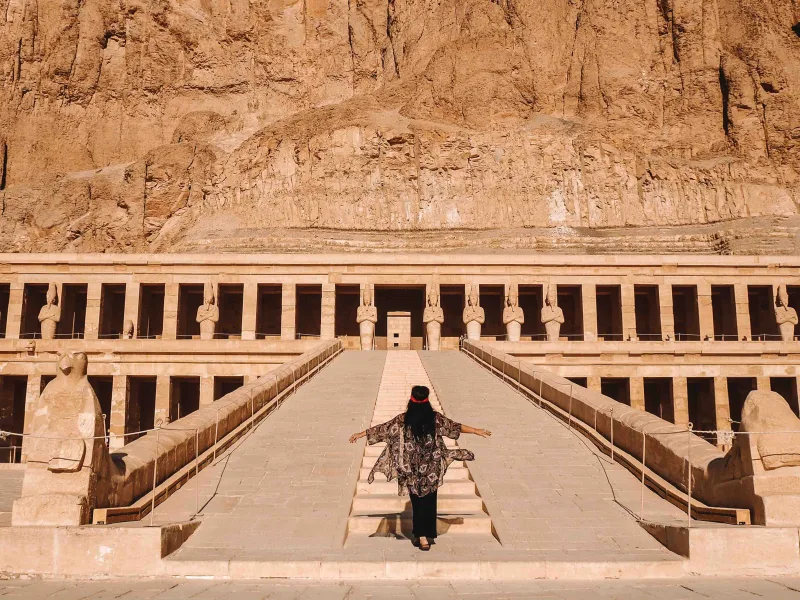
Completed around 1458 BC at Deir el-Bahari, the Temple of Hatshepsut is the finest surviving monument of Egypt's most successful female pharaoh — and one of the most original buildings of the ancient world. Instead of the massive pylons and enclosed courts of other New Kingdom temples, its three colonnaded terraces rise in clean horizontal lines, linked by long ramps and set so perfectly against the natural amphitheatre of cliffs that the architecture seems to grow out of the mountain itself.

Dedicated above all to Amun-Ra, the temple also held chapels of Hathor and Anubis and the mortuary cult of Hatshepsut and her father Thutmose I. Its walls carry some of the most famous reliefs in Egypt — the queen's divine birth and the great trading expedition to Punt. Today it is the centrepiece of every Luxor West Bank tour, usually paired with the nearby Valley of the Kings.

The three-tiered colonnades of the Temple of Hatshepsut at Deir el-Bahari

Unlike any other temple in Egypt

Terraces instead of pylons, porticoes instead of enclosing walls: the design borrows from the neighbouring 11th-Dynasty temple of Mentuhotep II but transforms it into something far grander. Many architectural historians count Djeser-Djeseru among the first great works of landscape architecture anywhere in the world.

Heart of the Theban Necropolis

The temple sits on a sacred axis with Karnak across the Nile, and the Valley of the Kings lies directly behind the cliff at its back. As part of the UNESCO-listed Ancient Thebes World Heritage Site, it anchors the classic West Bank circuit with the Colossi of Memnon and the royal tombs.

Plan a smarter visit

  • Come early — the east-facing terraces glow at sunrise and the site heats up fast after 10 AM.
  • Combine the temple with the Valley of the Kings and Colossi of Memnon on one West Bank morning.
  • Reliefs are sparsely labelled on site; an Egyptologist guide transforms what you see.

Hatshepsut: The Pharaoh Queen

Regent, then king: how a royal daughter took the throne of Egypt — and built a temple to keep it.

From regent to King of Upper and Lower Egypt

Daughter of Thutmose I and Great Royal Wife of Thutmose II, Hatshepsut became regent for her infant stepson Thutmose III around 1479 BC. Within seven years she had taken the full titles of a king, ruling as senior pharaoh for about 22 years — and being portrayed with the royal kilt and ceremonial false beard of kingship.

Her reign brought peace, booming trade and a building programme unmatched by any earlier queen: giant obelisks at Karnak, shrines across Egypt, and above all Djeser-Djeseru. The temple's Birth Colonnade carved her boldest claim in stone — that the god Amun-Ra himself was her father, making her rule divinely ordained.

Relief sculptures depicting the divine birth of Hatshepsut

Senenmut, the royal architect

A commoner who rose to become royal steward, tutor to the king's daughter and overseer of works, Senenmut is credited with the temple's revolutionary design. So great was his standing that he began a tomb for himself reaching beneath the temple's own forecourt — an almost unheard-of privilege.

The Punt reliefs showing ancient Egyptian trade expeditions

The voyage to Punt

Around year nine of her reign, Hatshepsut sent five ships down the Red Sea to the fabled Land of Punt. They returned with gold, ebony, ivory, leopard skins and live myrrh trees — planted on the temple terraces. The expedition reliefs, complete with the unforgettable Queen of Punt, are among the most celebrated in Egyptian art.

Architecture & Highlights, Terrace by Terrace

The temple climbs the cliff in three colonnaded levels joined by long processional ramps. Click each item for details.

Lower Terrace & the Grand RampThe processional approach
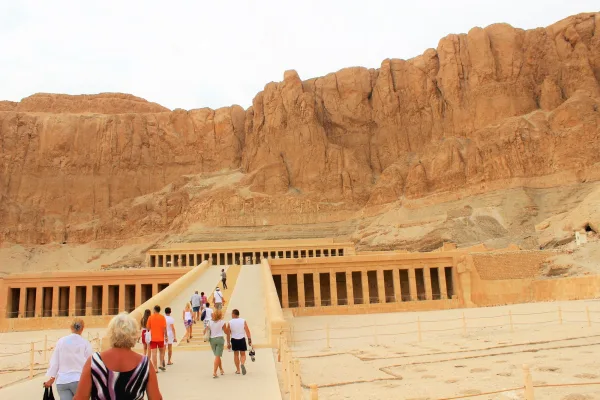
The grand approach and terraces of the Temple of Hatshepsut

A sphinx-lined causeway once led from the valley temple to this broad first court, planted with exotic myrrh trees brought back from Punt — their ancient root pits are still visible. From here the first great ramp rises to the porticoes above, framing the entire temple against the cliff face exactly as Senenmut intended.

Middle Terrace: Birth & Punt ColonnadesThe temple's most famous reliefs

The second level holds the temple's two legendary relief cycles. On the north side, the Birth Colonnade shows Amun-Ra taking the form of Thutmose I to father Hatshepsut — her divine claim to the throne. On the south, the Punt Colonnade records the great trading expedition ship by ship: loading the vessels, the stilted houses of Punt, and the famously corpulent Queen Ati of Punt.

Chapels of Hathor and AnubisColour that survived 3,500 years

Flanking the middle terrace are two side chapels. The Chapel of Hathor is instantly recognisable by its columns crowned with the cow-eared face of the goddess, who was worshipped at Deir el-Bahari long before the temple was built. The Chapel of Anubis preserves some of the site's most vivid original paint — its ceiling of golden stars on deep blue still glows.

Upper Terrace: Osiride Statues & Festival CourtHatshepsut as Osiris, ruler of eternity

The top level is fronted by a portico of Osiride statues — Hatshepsut standing as the god Osiris, arms crossed with crook and flail. Behind lies the festival courtyard where the sacred barque of Amun rested during the Beautiful Festival of the Valley, when Thebes crossed the river to honour its dead. This terrace, shattered in antiquity, was painstakingly reassembled by the Polish-Egyptian restoration mission.

Sanctuary of Amun & the Solar AlignmentDjeser-Djeseru in the strict sense

Cut directly into the living rock of the cliff, the innermost sanctuary of Amun is the temple's holiest point. The building is aligned toward the winter-solstice sunrise: in late December the dawn light penetrates the axis to illuminate the inner chambers — a piece of astronomical engineering shared with Abu Simbel.

Erased, Forgotten, Rediscovered

The temple's story didn't end with Hatshepsut — it was attacked, buried under rubble and a monastery, then pieced back together stone by stone.

The proscription of Thutmose III

Some two decades after her death, Hatshepsut's images and cartouches were systematically hacked out and her statues smashed into a quarry pit. Egyptologists today read it less as revenge than as dynastic politics — erasing a female precedent to secure the succession.

Amarna damage & later lives

Under Akhenaten, agents of the Aten chiselled out the temple's images of Amun, later restored by Ramesside kings. Earthquakes brought down colonnades, and in the 7th century AD a Coptic monastery — the "Northern Monastery", Deir el-Bahari — rose on the upper terrace, giving the site its modern name.

Rediscovery & restoration

Cleared by Auguste Mariette and fully excavated by Édouard Naville and Herbert Winlock from the 1890s, the temple has been restored since 1961 by the Polish-Egyptian mission, which reassembled the upper terrace from thousands of scattered fragments. The fully restored temple reopened to visitors in the 2000s.

Essential Visitor Information

Everything you need to plan your visit to Deir el-Bahari.

Tickets & opening hours

Open daily from 6:00 AM, closing around 5:00 PM in summer (April–September) and 4:00 PM in winter (October–March). Tickets are sold at the visitor centre, where an electric tram (small extra fee) runs up the causeway to the temple itself.

  • International ticket prices are revised frequently — check on arrival or book a tour with tickets included.
  • Students with a valid ID receive a discount; children's rates apply at most Luxor sites.
  • Personal photography is included with the standard ticket.

Getting there & combining sights

Deir el-Bahari is on Luxor's West Bank, 30–40 minutes from the city centre by road — or faster by motorboat across the Nile plus a short taxi. Nearly all guided Luxor tours include hotel pickup and pair the temple with its neighbours.

  • Valley of the Kings — just over the ridge, 15 minutes by road.
  • Colossi of Memnon — on the main West Bank road, a 10-minute stop.
  • Medinet Habu & the Valley of the Queens — easy add-ons for a full morning.

Tips from our guides

  • There is almost no shade on the terraces — bring a hat, sunscreen and water, especially May–September.
  • Allow 1.5–2 hours on site; the Chapel of Anubis and the Punt reliefs reward unhurried viewing.
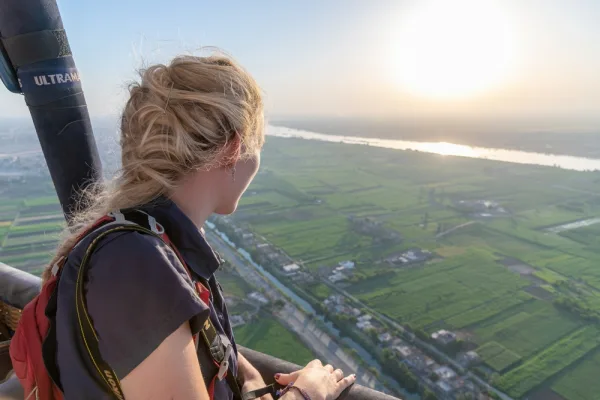
  • At dawn, hot-air balloons launch nearby and drift directly over Deir el-Bahari — an unforgettable way to see the temple from above.

The Temple of Hatshepsut by the Numbers

c. 1479 BCConstruction began under Hatshepsut
15Years to complete Djeser-Djeseru
3Colonnaded terraces linked by ramps
700 mStraight-line distance to the Valley of the Kings

Frequently Asked Questions

Everything travellers ask about visiting the Temple of Hatshepsut.

When was the Temple of Hatshepsut built?
The Temple of Hatshepsut was built approximately between 1479 and 1458 BC, during the 18th Dynasty of the New Kingdom. Construction began around the seventh year of Hatshepsut's reign and took roughly 15 years to complete.
Where is the Temple of Hatshepsut located?
The temple stands at Deir el-Bahari on the west bank of the Nile opposite Luxor, Egypt. It is built directly against the limestone cliffs of the Theban mountain, roughly 700 metres in a straight line from the Valley of the Kings, and forms part of the UNESCO-listed Theban Necropolis.
Who was Hatshepsut?
Hatshepsut (c. 1507–1458 BC) was the fifth pharaoh of the 18th Dynasty and one of the very few women to rule Egypt as king. Initially regent for her young stepson Thutmose III, she assumed full royal titles and reigned for about 22 years — a period remembered for peace, flourishing trade and ambitious building projects.
What does Djeser-Djeseru mean?
Djeser-Djeseru means "Holy of Holies" in ancient Egyptian. Strictly it names the temple's innermost sanctuary of Amun, but it is used for the monument as a whole — the terraced temple was considered one of the most sacred places in Thebes.
Why was the Temple of Hatshepsut built?
The temple served several purposes at once: it was Hatshepsut's mortuary temple, where her cult would be celebrated after her death; a sanctuary of the god Amun-Ra; and a political statement in stone, with reliefs of her divine birth and the expedition to Punt legitimising her right to rule as a female pharaoh.
Who designed the Temple of Hatshepsut?
Senenmut, Hatshepsut's royal steward and one of the most remarkable commoners of ancient Egypt, is credited as the temple's chief architect. He took inspiration from the neighbouring 11th-Dynasty temple of Mentuhotep II but multiplied its terraces and scale, creating a design unique in Egyptian architecture.
What is the Temple of Hatshepsut made of?
The temple is constructed primarily from local limestone quarried from the surrounding cliffs, with some sandstone and granite elements. The walls and colonnades were covered with painted reliefs using mineral pigments — traces of the original colours still survive, especially in the Chapel of Anubis.
Why were Hatshepsut's images destroyed?
About two decades after Hatshepsut's death, Thutmose III ordered her images and cartouches systematically erased and her statues smashed — most likely to secure the succession for his son rather than out of personal hatred. Later, Akhenaten's agents also chiselled out images of Amun. Many reliefs have since been carefully restored.
What are the opening hours of the Temple of Hatshepsut?
The temple opens daily at 6:00 AM and typically closes at 5:00 PM in summer (April–September) and 4:00 PM in winter (October–March). Opening times can change around major holidays, so check locally or book a guided tour.
How much does it cost to visit the Temple of Hatshepsut?
Ticket prices for international visitors are revised almost every season — recent seasons have been in the few-hundred-EGP range — with discounts for students holding a valid ID, and a small extra fee for the electric tram from the visitor centre. Guided Luxor tours from around €33 usually include tickets, transport and an Egyptologist guide.
How do I get to the Temple of Hatshepsut from Luxor?
The temple is on Luxor's West Bank, about 30–40 minutes from the city centre via the bridge, or quicker by motorboat across the Nile plus a short taxi ride. Most visitors come on a guided West Bank tour with hotel pickup; from the ticketed visitor centre, an electric tram or a short walk takes you up the causeway to the temple.
Can I combine the temple with the Valley of the Kings?
Yes — almost every West Bank itinerary pairs them. The Valley of the Kings lies just over the ridge behind the temple (about 700 metres in a straight line, 15 minutes by road), and most Luxor day tours combine the two with the Colossi of Memnon and often Medinet Habu or the Valley of the Queens.
Is photography allowed at the Temple of Hatshepsut?
Yes, photography for personal use is allowed with a standard ticket, including phones and standard cameras. Tripods and professional equipment may require a separate permit, and drone photography is prohibited in Egypt without special government permission.
When is the best time to visit the Temple of Hatshepsut?
Early morning (6:00–9:00 AM) is best: the temple faces east, so sunrise light strikes the terraces directly, temperatures are cooler and the tour-bus crowds arrive later. October to April offers the most comfortable weather — and at dawn, hot-air balloons drift right over Deir el-Bahari.

Need more information?

Our team is happy to help — reach out via WhatsApp, email, or call +20 101 195 7868.

Walk the Terraces of Egypt's Pharaoh Queen

Book a guided Luxor tour with hotel pickup and an expert Egyptologist — from West Bank mornings pairing the Temple of Hatshepsut with the Valley of the Kings, to sunrise hot-air balloon flights over Deir el-Bahari. Luxor tours from €33 per person.

View Luxor Tours WhatsApp
Chat with us!

Site map

39

Related pages & tours

Luxor day tours Luxor travel guide Valley of the Kings Karnak Temple