Discover the sacred hieroglyphic writing system of ancient Egypt. Translate names, learn hieroglyphics alphabet, decode symbols, and explore 3,000+ years of Egyptian hieroglyphic history
Free Egyptian Hieroglyphics Translator: Translate Names to Hieroglyphs
Use our free hieroglyphics translator to convert English names to authentic Egyptian hieroglyphs. Copy paste hieroglyphics, download as image, or share your hieroglyphic name translation.
Names are translated phonetically based on how they would have sounded.
0 characters
More Options
Style:
Color:
Background:
Your name in hieroglyphs:
𓀀 𓀁 𓀂𓀃 𓀄 𓀅
Enter your name above to see it in hieroglyphs
Translating...
Pronunciation:-
Direction:Right to left (authentic)
How the Hieroglyphics Translator Works
Our free hieroglyphics translator converts modern English names into their phonetic Egyptian hieroglyphic equivalents. Since ancient Egyptian writing didn't record vowels exactly like we do, the translation focuses on consonant sounds using the 24-letter hieroglyphics alphabet.
The hieroglyphs are displayed in the authentic right-to-left direction, just as they would appear on temple walls. You can copy paste hieroglyphics directly, download your hieroglyphic name as an image, or share it on social media.
Pro Tip:You can copy and paste hieroglyphics from our translator using Unicode support. Since 2009, Egyptian hieroglyphs are included in Unicode (U+13000 to U+1342F), making it easy to use hieroglyphics in any document or application.
𓎏
Translate Words & Phrases Beta
Type English words. Real Ancient Egyptian words appear in gold; unknown words fall back to phonetic spelling.
Try:
Real Ancient Egyptian wordPhonetic spelling
Currently English only. The name translator above works in any language.
Egyptian Hieroglyphs Quick Facts
What are hieroglyphs? Sacred Egyptian writing system using pictures and symbols
How many hieroglyphs exist? Approximately 1,000 distinct characters
When were they used? 3200 BCE to 394 CE (over 3,500 years)
Who could read them? Only 1% of ancient Egyptians (mainly priests and scribes)
How to read hieroglyphs? Look at which way figures face - they point to the beginning
𓂀
Ancient Egyptian Hieroglyphs & Hieroglyphics: The Divine Script
Complete Guide to Egyptian Hieroglyphs: The Sacred Hieroglyphic Writing System of Ancient Egypt
The ancient Egyptians called their writing medu netjer – "the words of the gods." More than just a way to record information, hieroglyphs (also called hieroglyphics) were believed to hold magical power, bringing what they depicted into existence through their sacred forms.
This extraordinary hieroglyphic writing system combined beautiful artistic elements with practical communication, remaining largely unchanged for over three millennia – making Egyptian hieroglyphs and hieroglyphics one of the world's longest-lived writing systems.
Egyptian hieroglyphs and hieroglyphics first appeared around 3200 BCE, emerging from simple pictographic symbols into the sophisticated system that adorned monuments throughout the Nile Valley. Unlike our alphabet today, hieroglyphs comprised nearly 1,000 distinct hieroglyphic characters including pictograms, ideograms, and phonetic signs. The Egyptian hieroglyphics alphabet consists of 24 single-consonant signs that function similarly to modern alphabet letters.
The word "hieroglyph" (or hieroglyphics) comes from Greek hieroglyphikos, meaning "sacred carved letters" – perfectly capturing their dual nature as both communication tool and sacred art. For ancient Egyptians, these hieroglyphic symbols weren't merely writing but a divine gift from Thoth, the ibis-headed god of wisdom.
When used in religious contexts, hieroglyphs were meticulously carved and often painted in vibrant colors. In contrast, everyday Egyptian hieroglyphs evolved into cursive forms called hieratic script and later demotic script for more practical purposes like record-keeping and correspondence. The ancient Egyptian language was recorded using these various Egyptian writing systems. Today, you can see authentic hieroglyphic inscriptions at sites throughout Egypt, including the temples of Luxor and Karnak, the pyramids near Cairo, and in museums like the Egyptian Museum.
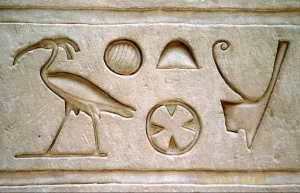
Hieroglyphic inscription from an ancient Egyptian temple
3,000+Years in continuous use
~1,000Unique hieroglyphic symbols
1822Year hieroglyphs were deciphered
Egyptian hieroglyphs were not merely a way to write – they were believed to breathe life into what they depicted, making them essential for the deceased's journey into the afterlife. Ancient Egyptian History
𓏋
Complete Guide to Egyptian Hieroglyphs, Hieroglyphics Alphabet & Symbols
Decoding the Sacred Hieroglyphic Writing System: Learn Ancient Egyptian Hieroglyphs, Alphabet, and Symbol Meanings
Egyptian Hieroglyphs: The Ancient Writing System
Hieroglyphic writing emerged around 3200 BCE and remained in use for over 3,500 years, making it one of history's longest-lived writing systems. Unlike our modern alphabets, Egyptian hieroglyphs comprised nearly 1,000 distinct characters with multiple functions. Understanding these different types of hieroglyphs is essential to appreciating the sophistication of this ancient writing system. Visitors to Egypt can see these hieroglyphs firsthand at sites like the Valley of the Kings in Luxor, where pharaohs' tombs are covered in hieroglyphic inscriptions.
The Egyptian Hieroglyphics Alphabet: 24 Single-Consonant Signs
The Egyptian hieroglyphics alphabet consists of 24 uniliteral signs (single-consonant hieroglyphs) that function similarly to modern alphabet letters. These hieroglyphic alphabet signs represent individual consonant sounds and form the foundation of Egyptian hieroglyphic writing.
𓄳
ꜣ (A)
Vulture
𓃀
b
Leg
𓎡
k
Basket
𓂧
d
Hand
𓇋
ị (i)
Reed
𓉔
ḥ
Reed Shelter
𓅓
m
Owl
𓈖
n
Water
𓅱
w
Quail Chick
𓊪
p
Stool
𓂋
r
Mouth
𓋴
s
Fold of Cloth
𓐏
t
Bread Loaf
𓊃
z
Door Bolt
These 24 hieroglyphic alphabet signs form the foundation of Egyptian hieroglyphics. Combined with biliterals, triliterals, ideograms, and determinatives, they create the complete hieroglyphic writing system used for over 3,000 years in ancient Egypt.
Primary Types of Egyptian Hieroglyphic Symbols
𓅓
Phonograms
Signs that represent sounds, similar to our alphabet. For example, the owl (\u{13153}) represented the sound "m".
𓅓m
𓂋r
𓆓ḥ
Phonograms formed the backbone of Egyptian writing, with about 24 single-consonant signs functioning similar to an alphabet.
𓇋
Ideograms
Signs that represent entire ideas or objects. For example, the sun disk (\u{131F3}) represented both the sun and the sun god Ra.
𓇳sun/day
𓁶see
𓈗water
Ideograms could stand alone to represent complete concepts, making hieroglyphic writing remarkably efficient for conveying meaning.
𓐍
Determinatives
Silent signs added to the end of words to clarify meaning. They helped distinguish between words that sounded the same.
𓀀man/person
𓆊reptile
𓁻motion
Since Egyptian writing didn't record vowels, determinatives helped clarify the meaning of words that might otherwise be confused.
𓎛
Biliterals & Triliterals
Special signs that represent two or three consonants together, creating efficient shorthand for common sound combinations.
𓎡k3
𓋴𓍂stp
𓐍𓅱ḫpr
Scribes used these multi-consonant signs alongside single-consonant signs for efficiency and aesthetic purposes.
𓁹𓁹
Logograms
Signs that represent entire words with their exact pronunciation, rather than just their general meaning.
𓅨nṯr (god)
𓉐pr (house)
𓂓ir (do)
Logograms were among the earliest hieroglyphs and many derived from simple pictorial representations of the objects they described.
𓍢
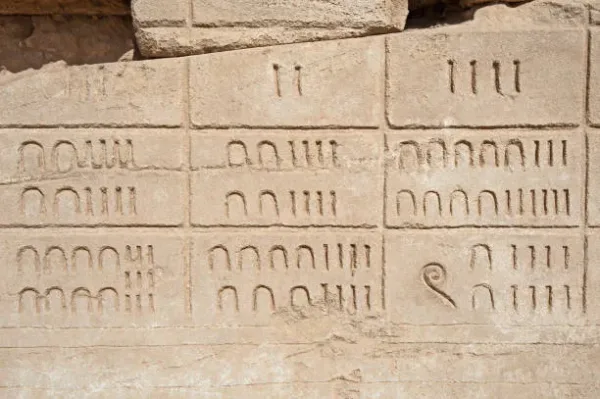
Numerical Hieroglyphs
Special signs used for counting and mathematical notation in ancient Egypt.
1
𓎆10
𓍢100
The ancient Egyptian number system was decimal, with unique symbols for powers of ten up to one million.
Reading Egyptian Hieroglyphs: Deciphering Ancient Symbols
One of the most fascinating aspects of hieroglyphic writing is its flexibility in direction. Hieroglyphs could be written and read from right to left, left to right, or top to bottom. However, the ancient Egyptians developed a clever visual system to indicate reading direction:
Human and animal figures always face toward the beginning of the text
When reading multiple lines, the upper line comes before the lower line
When signs are arranged vertically, the top sign usually comes first
Text can wrap around corners or architectural features while maintaining reading direction
While hieroglyphs could be written in any direction, right-to-left was most common for religious texts, while administrative documents often used vertical columns.
Right to Left Example𓀀 𓁹 𓀰 𓉔 𓐏 𓊖Notice figures facing right (toward beginning)
Left to Right Example𓊖 𓐏 𓉔 𓀰 𓁹 𓀀Notice figures facing left (toward beginning)
Special Forms of Egyptian Hieroglyphs and Royal Symbols
𓍹𓍺
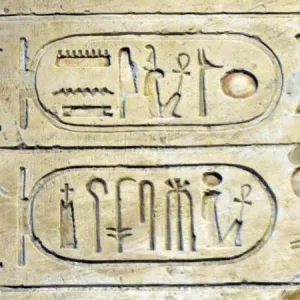
Cartouches
Oval enclosures surrounding royal names, signifying that the enclosed hieroglyphs spelled out the name of a pharaoh or queen. The cartouche symbolized that the king's name encompassed "all that the sun circles."
𓉔𓐎
Serekhs
Rectangular enclosures representing palace fa\u{00E7}ades, used to frame the Horus names of early Egyptian kings before cartouches became standard.
𓈒
Cryptographic Hieroglyphs
Special encoded hieroglyphs used in religious texts that deviated from standard meanings, creating a secret writing system understood only by initiated priests.
How Egyptian Hieroglyphs Were Written: Ancient Tools and Techniques
Papyrus Writing
Scribes used reed pens (called qalam) dipped in ink made from soot or ochre mixed with water and gum arabic. They carried specialized palettes with wells for different colored inks.
Stone Carving
For monumental inscriptions, artisans first outlined hieroglyphs with red paint, then carved them using copper chisels and wooden mallets. Many were painted after carving.
Training Process
Scribal training began around age 10 and lasted over a decade. Students practiced on ostraca (pottery shards) and wooden tablets before graduating to papyrus.
Artistic Considerations
Scribes arranged hieroglyphs carefully for aesthetic balance, sometimes adjusting sign placement or size to create visually pleasing compositions.
Despite being a pictorial system, hieroglyphs had to conform to a conceptual square grid, with signs like birds and people sized to fit perfectly within these invisible grid spaces.
Common Words and Phrases in Egyptian Hieroglyphs
𓋹𓈖𓐍ʿnḫLife
𓊤𓐏𓄊𓐏nfrtBeautiful
𓇓𓅱𓐏𓊖kmtEgypt (The Black Land)
𓅓𓂝𓂝𓐏m3ʿtTruth/Justice
𓂓𓐎𓅱𓐛𓀀rmtPerson/Human
Complete Phrases
𓋹𓈖𓐍𓃀𓇋𓐏𓅱𓋴𓈖𓃀ʿnḫ wḏ3 snb"Life, Prosperity, Health" - Common blessing on royal inscriptions
𓊃𓐏𓊇𓇋𓆛𓐛𓊖st hmt-nsw"King's Wife" - Title for the principal queen
Fascinating Facts About Egyptian Hieroglyphic Symbols
Creative Spelling
Egyptian scribes could spell the same word in multiple different ways, sometimes even within the same text, choosing different combinations of signs for aesthetic or space considerations.
Honorific Transposition
Signs representing deities or the king were often placed first in a word regardless of their actual pronunciation order, as a sign of respect.
Hidden Messages
Scribes occasionally inserted hidden messages or visual puns within hieroglyphic texts that would only be understood by the highly educated.
Avoiding the "Dangerous"
Signs depicting dangerous animals were sometimes drawn incomplete or with knives in them to neutralize their potential magical power to harm the deceased in tomb inscriptions.
Rebus Writing
Some hieroglyphs functioned like visual rebuses, using pictures of objects whose names sounded like the intended word, similar to using an image of an "eye" to represent "I" in English.
No Punctuation
Hieroglyphic writing lacked punctuation or spaces between words, requiring readers to determine word boundaries from context and determinative signs.
Evolution of Egyptian Hieroglyphs Through History
3500-3200 BCE
Proto-Hieroglyphic Phase
Early pictographic symbols appear in Predynastic Egypt, primarily used for labels and identification marks.
3000-2600 BCE
Formative Period
Early Dynastic Period sees development of systematic hieroglyphic writing with standardized signs and basic grammar.
2600-2000 BCE
Classical Hieroglyphs
Old Kingdom period establishes the classic form of hieroglyphic writing with fully developed grammar and extensive vocabulary.
2000-1000 BCE
Expansion and Refinement
Middle and New Kingdom periods see expansion of the hieroglyphic repertoire and development of artistic variations.
1000-30 BCE
Late Period Innovations
Late and Ptolemaic periods introduce new signs and expanded use of cryptographic writing.
30 BCE-394 CE
Final Phase and Decline
Roman period sees gradual decline in hieroglyphic literacy, with the last dated inscription carved at Philae in 394 CE.
Decipherment and Modern Study of Egyptian Hieroglyphs
The Rosetta Stone: Key to Unlocking Egyptian Hieroglyphic Writing
Discovered in July 1799 by French officer Pierre-Fran\u{00E7}ois Bouchard during Napoleon Bonaparte's Egyptian campaign, the Rosetta Stone became the most crucial artifact in Egyptian hieroglyphs translation history. This remarkable granite stele contained the same decree in three scripts: ancient Egyptian hieroglyphs, Demotic script, and Ancient Greek—providing the essential parallel text that would finally unlock the mysteries of hieroglyphic writing after 1,500 years of silence. The Rosetta Stone is now housed in the British Museum in London, where it remains one of the most visited artifacts in the world.
The breakthrough in hieroglyphic decoding came from French scholar Jean-Fran\u{00E7}ois Champollion, who announced his momentous discovery in 1822. Building upon preliminary work by English physicist Thomas Young, Champollion identified that hieroglyphic writing contained both phonetic and ideographic elements—a critical insight that previous scholars had missed. While Young had correctly identified the phonetic value of several signs, it was Champollion's comprehensive understanding of the Coptic language (the final stage of ancient Egyptian) that allowed him to make the definitive breakthrough in hieroglyphic decipherment.
Champollion's famous letter to Monsieur Dacier on September 27, 1822, revealed his discovery that hieroglyphs represented sounds, not just concepts as previously believed. His groundbreaking work "Pr\u{00E9}cis du syst\u{00E8}me hi\u{00E9}roglyphique" (1824) established the foundation for all modern understanding of Egyptian hieroglyphic writing. Today, scholars continue to study hieroglyphs using resources from institutions like the Metropolitan Museum of Art and academic programs in Egyptology worldwide.
Timeline of Hieroglyphic Decipherment
1799: Discovery of the Rosetta Stone during Napoleon's Egyptian campaign
1814: Thomas Young identifies the phonetic value of several hieroglyphic signs in royal cartouches
1822: Jean-Fran\u{00E7}ois Champollion announces his breakthrough in deciphering hieroglyphic writing
1836: Publication of Champollion's Egyptian grammar, posthumously completed by his brother
1850s: Karl Richard Lepsius standardizes the classification of hieroglyphs and publishes the first typeface
1927: Sir Alan Gardiner publishes his "Egyptian Grammar," becoming the standard reference work
2009: Egyptian hieroglyphs are incorporated into the Unicode Standard, enabling digital representation
Modern Hieroglyphic Research and Digital Egyptology
Today, scholars employ sophisticated digital technologies to study ancient Egyptian hieroglyphic inscriptions with unprecedented precision. The field of Digital Egyptology has revolutionized hieroglyphic research through advanced computational techniques and digital preservation methods:
The Manuel de Codage (MdC) system provides standardized encoding for representing hieroglyphic texts digitally, allowing consistent data exchange between researchers
The Thesaurus Linguae Aegyptiae database contains thousands of transcribed and translated hieroglyphic texts, enabling comprehensive linguistic analysis
Unicode support for hieroglyphs (added in 2009) ensures proper digital representation of hieroglyphic characters across computing platforms
Digital epigraphy techniques combine photography, 3D scanning, and computational analysis to record and preserve fragile hieroglyphic inscriptions
The Ancient Egyptian Dictionary Project is compiling the most comprehensive lexicon of hieroglyphic vocabulary ever attempted
Machine learning algorithms are being developed to assist in the restoration of damaged hieroglyphic texts and identification of scribal patterns
Electronic databases of temple and tomb inscriptions allow instant access to hieroglyphic texts from remote archaeological sites
Despite the successful decipherment of hieroglyphs two centuries ago, scholarly understanding of ancient Egyptian language continues to evolve. Ongoing research reveals new insights into pronunciation, grammar, and vocabulary, while newly discovered texts regularly expand our knowledge of this ancient writing system.
Modern Applications of Hieroglyphic Studies
Linguistic Research
Hieroglyphic writing provides invaluable insights into the evolution of human language systems and the development of written communication across cultures.
Cultural Heritage Preservation
Digital recording of hieroglyphic inscriptions helps preserve Egypt's cultural heritage against threats from climate change, urbanization, and tourism.
Educational Technology
Interactive digital tools for learning hieroglyphs make this ancient writing system accessible to students and enthusiasts worldwide.
These groundbreaking digital approaches continue to deepen our understanding of ancient Egyptian hieroglyphic writing and the remarkable civilization that created this enduring script. As technology advances, researchers can uncover new dimensions of hieroglyphic texts that were previously inaccessible, bringing us ever closer to comprehending the full richness of this ancient writing system.
Powerful Hieroglyphic Symbols and Signs in Ancient Egyptian Culture: Complete Guide to Egyptian Hieroglyph Meanings
Sacred Egyptian Symbols & Hieroglyphic Signs: Common Hieroglyphs and Their Meanings
<strong>Egyptian hieroglyphs</strong> and <strong>hieroglyphics</strong> were more than just a writing system—many <strong>hieroglyphic symbols</strong> held profound religious and magical significance. These sacred <strong>Egyptian symbols</strong> were believed to possess power and were carefully selected for tombs, temples, and amulets to invoke divine protection and blessings. Understanding <strong>ancient Egyptian symbols</strong> and their meanings provides insight into the <strong>ancient Egyptian language</strong> and <strong>Egyptian culture</strong>.
𓂀
Eye of Horus (Wedjat)
Symbol of protection, royal power, and good health. Represents the eye of the god Horus that was wounded in his battle with Seth and then healed by Thoth.
𓋹
Ankh
Symbol of life and immortality, often carried by gods. Egyptians wore ankh amulets for protection and to ensure their soul's journey into the afterlife.
𓊽
Djed Pillar
Symbol of stability and the backbone of Osiris. Represented endurance and everlasting strength, often used in funerary contexts to ensure eternal life.
𓇳
Sun Disk (Ra)
Symbol of the sun god Ra and divine power. Often depicted with wings or surrounded by protective cobras, representing the sun's journey across the sky.
𓆣
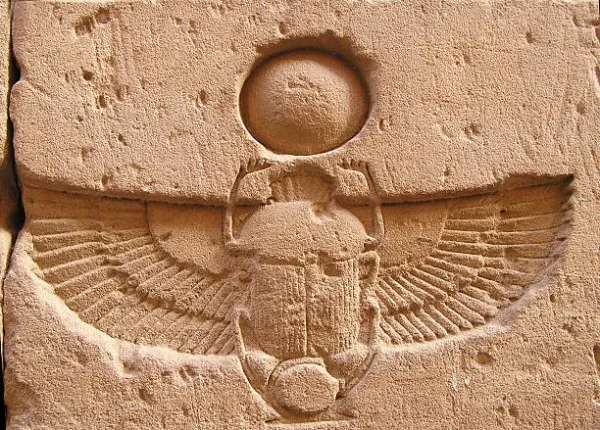
Scarab Beetle
Symbol of rebirth, transformation, and creation. Sacred to Khepri, a form of the sun god who pushed the sun across the sky like the beetle pushes its ball of dung.
𓆄
Feather of Maat
Symbol of truth, justice, and cosmic order. In the afterlife judgment, the deceased's heart was weighed against this feather to determine their fate.
𓋾
Was Scepter
Symbol of power and dominion. This staff with a forked base and animal-headed top was carried by deities to signify their control over forces of chaos.
𓋹
Tyet (Isis Knot)
Associated with the goddess Isis, this symbol resembles an ankh with tied arms and represents divine protection and the blood of Isis.
𓆸
Lotus Flower
Symbol of rebirth and creation. The lotus, which closes at night and reopens in the morning, represented the sun's daily cycle of death and rebirth.
𓅱
Quail Chick
This seemingly simple hieroglyph was one of the most common in Egyptian writing, representing the sound "w" and appearing in countless inscriptions.
Powerful Egyptian Symbols Combinations
Egyptians often combined symbols to create more powerful protective emblems:
Ankh, Djed, and Was
Combined to represent the concepts of life, stability, and power, often carried together by deities.
Eye of Horus with Hand
A powerful protective combination that amplified the defensive properties of the Eye of Horus.
Sun Disk with Ankh
Symbolizing the life-giving power of the sun, often depicted with rays ending in ankh symbols.
Hieroglyphs as Amulets
Many hieroglyphic symbols were worn as protective amulets by ancient Egyptians:
The Wedjat Eye protected against evil and illness
The Scarab ensured rebirth and protection for the heart
The Ankh provided life force and longevity
The Djed Pillar granted stability and strength
Amulets were crafted from precious materials like gold, silver, and semi-precious stones, each chosen for its magical properties.
Ancient Egyptian amulets found in tombs, shaped as sacred hieroglyphs
These symbols weren't just writing elements – they held deep religious and magical significance in ancient Egyptian culture. Their presence in temples, tombs, and personal items was believed to invoke divine powers and protection.
Tours, activities, and day trips in Egypt's most popular destinations
Explore Best Things to Do – Top Destinations
From the pyramids of Cairo to the temples of Luxor and the Red Sea coast – discover tours and experiences in the same destinations you see in the site menu. Book things to do, day trips, and excursions in each region.
Discover fascinating articles about ancient Egyptian civilization
Explore Our Egyptian Blog
Dive deeper into the mysteries and wonders of ancient Egypt with our collection of insightful articles. From powerful symbols to beauty secrets, gods and goddesses to famous mummies – our blog reveals the fascinating stories of this extraordinary civilization.
Everything you need to know about ancient Egyptian writing
Comprehensive Guide to Egyptian Hieroglyphs: Frequently Asked Questions
Basics & Definition
Egyptian hieroglyphs are a formal writing system used by ancient Egyptians that combines beautiful artistic elements with practical communication. The word "hieroglyph" comes from Greek meaning "sacred carved letters." Ancient Egyptians called their writing system "medu netjer" (the words of the gods), believing these symbols held magical power. Hieroglyphs comprised nearly 1,000 distinct characters including pictograms, ideograms, and phonetic signs, making it one of the world's most sophisticated writing systems.
The word "hieroglyphs" comes from the Greek words "hieros" (sacred) and "glyphein" (to carve), literally meaning "sacred carved letters." This name perfectly captures their dual nature as both a communication tool and sacred art form. The ancient Egyptians themselves called their writing "medu netjer," which translates to "the words of the gods," reflecting their belief that this writing system was divine in origin.
"Hieroglyphs" refers to the individual symbols or characters themselves, while "hieroglyphics" refers to the writing system as a whole. For example, you would say "these hieroglyphs spell my name" but "hieroglyphics was used in ancient Egypt." Both terms are commonly used and understood, but "hieroglyphs" is more precise when referring to specific symbols.
While Chinese characters and Egyptian hieroglyphs are both logographic writing systems that can represent ideas through pictures, they are distinct systems that developed independently. Chinese characters evolved from ancient pictographs but have their own unique structure and development. The term "hieroglyphs" specifically refers to the ancient Egyptian writing system, though the comparison helps illustrate how pictographic writing works.
Egyptian hieroglyphs and modern emojis share fascinating similarities as pictographic communication systems. Both use visual symbols to represent ideas, emotions, and concepts directly. Like hieroglyphs, emojis can function as ideograms (representing complete ideas), phonetic elements (rebus writing), and determinatives (clarifying meaning). However, emojis lack the sophisticated grammatical structure and phonetic complexity of hieroglyphs. Some scholars consider emojis a return to pictographic communication, though they supplement rather than replace alphabetic writing as hieroglyphs did.
Egyptian hieroglyphs include hundreds of different objects and animals from ancient Egyptian life. The standard sign list includes approximately 200+ animal signs (birds, mammals, reptiles, fish, insects), 150+ human figures and body parts, 100+ architectural and furniture items, 80+ tools and weapons, 60+ plants and trees, and 50+ geographical features. Common animals include various birds (ibis, owl, falcon, duck), mammals (lion, bull, cat, hippopotamus), reptiles (cobra, crocodile), and insects (bee, beetle). Objects range from everyday items like bread, water jars, and sandals to royal regalia like crowns and scepters. This vast repertoire reflects the rich natural environment and sophisticated material culture of ancient Egypt.
History & Origins
Egyptian hieroglyphs weren't invented by a single person but evolved gradually from simple pictographic symbols around 3200 BCE during Egypt's Predynastic period. The system developed organically as ancient Egyptians needed to record information about trade, administration, and religious practices. According to Egyptian mythology, the god Thoth was credited with giving the gift of writing to humanity, but in reality, hieroglyphs emerged through collective cultural development over several centuries.
Egyptian hieroglyphs first appeared around 3200 BCE, making them over 5,000 years old. The earliest examples date to the late Predynastic period (c. 3200-3100 BCE), with the system reaching full development by the early Dynastic period (c. 3100-2686 BCE). Hieroglyphs remained in continuous use for over 3,500 years, with the last known hieroglyphic inscription carved at the Temple of Philae in 394 CE.
Hieroglyphs developed from the practical need to record information in an increasingly complex society. As ancient Egypt grew from simple farming communities to a sophisticated civilization, people needed ways to track trade, record laws, document religious ceremonies, and communicate across distances. The system began with simple pictures representing objects and gradually evolved to include symbols representing sounds and abstract concepts. This development paralleled Egypt's political unification and the growth of its administrative state.
Hieroglyphs gradually declined during the Roman period (30 BCE - 394 CE) rather than disappearing under a specific ruler. The spread of Christianity in Egypt, which favored Coptic script, and the Roman administration's use of Latin and Greek contributed to hieroglyphs' decline. The last dated hieroglyphic inscription was carved in 394 CE at the Temple of Philae during the reign of Roman Emperor Theodosius I. By this time, knowledge of how to read and write hieroglyphs had already been lost to most of the population.
The alphabet was born from hieroglyphs through a fascinating process of simplification and cultural transmission. Around 1700 BCE, Semitic peoples living in Egypt adapted certain Egyptian hieroglyphic signs to write their own language, creating the first alphabetic script called Proto-Sinaitic. They took the acrophonic principle - using the first sound of a word the picture represented. For example, the Egyptian hieroglyph for "house" (pronounced "per") became the letter that represented the "p" sound. The Egyptian ox-head hieroglyph became "aleph" (meaning ox in Semitic), which evolved into our letter "A." This proto-alphabet spread throughout the Mediterranean, evolving into Phoenician, then Greek, Latin, and eventually our modern alphabet. So our ABCs are direct descendants of ancient Egyptian hieroglyphs, making every time we write a connection to ancient Egypt.
The ancient Egyptians themselves were the first to demonstrate the supreme importance of the sun in their hieroglyphic writing system from the very beginning of their civilization. The sun disk hieroglyph was among the earliest and most significant symbols, representing both the physical sun and the sun god Ra, who was considered the king of all gods. During the reign of Pharaoh Akhenaten (c. 1353-1336 BCE), the importance of the sun reached its peak when he revolutionized Egyptian religion to focus almost exclusively on Aten, the sun disk. Akhenaten's hieroglyphic inscriptions at his capital city Akhetaten (Tell el-Amarna) show the sun disk with rays ending in hands, emphasizing the sun's life-giving power. The sun hieroglyph appears in countless royal names, religious texts, and daily inscriptions throughout Egyptian history, making it one of the most frequently used and important symbols in the entire hieroglyphic system.
Hieroglyphs first appeared in Egypt around 3200-3100 BCE during the late Predynastic period, making them contemporary with the earliest Mesopotamian cuneiform writing. The earliest known hieroglyphic inscriptions appear on labels, pottery, and ceremonial objects from royal tombs at Abydos and Hierakonpolis. These proto-hieroglyphic symbols initially served primarily as labels and identifiers, gradually developing into the sophisticated writing system we recognize. The famous Narmer Palette (c. 3100 BCE) contains some of the earliest royal hieroglyphic inscriptions, marking the transition from pictographic symbols to true hieroglyphic writing. By the Early Dynastic Period (c. 3100-2686 BCE), hieroglyphs had developed into a fully functional writing system capable of recording the Egyptian language with all its grammatical complexity.
Reading & Decipherment
Reading hieroglyphs requires understanding that they can be read in multiple directions: right to left, left to right, or top to bottom. The key is to look at which way human and animal figures are facing - they always face toward the beginning of the text. Hieroglyphs combine three types of signs: phonetic symbols (representing sounds), ideograms (representing complete ideas), and determinatives (clarifying meaning). Learning to read hieroglyphs involves memorizing these different sign types and understanding Egyptian grammar.
French scholar Jean-François Champollion successfully deciphered Egyptian hieroglyphs in 1822. His breakthrough came after studying the Rosetta Stone, which contained the same text in hieroglyphic, demotic, and Greek scripts. While English physicist Thomas Young had made preliminary progress identifying some phonetic values, Champollion's comprehensive understanding of Coptic (the final stage of ancient Egyptian) allowed him to make the definitive breakthrough. He announced his discovery in his famous letter to Monsieur Dacier on September 27, 1822.
The Rosetta Stone, discovered in 1799 by French officer Pierre-François Bouchard during Napoleon's Egyptian campaign, provided the key to deciphering hieroglyphs. This granite stele contained the same decree written in three scripts: ancient Egyptian hieroglyphs, demotic script, and ancient Greek. Since scholars could read ancient Greek, they could use it as a "crib" to understand the meaning of the hieroglyphic and demotic texts, eventually leading to Champollion's breakthrough in 1822.
Several factors made deciphering hieroglyphs extremely challenging: First, scholars initially believed each hieroglyph represented a complete idea or object (pictograms) rather than sounds, which was incorrect. Second, the Egyptian language had been "dead" for over 1,000 years, with no native speakers. Third, hieroglyphic writing doesn't include vowels, making pronunciation unclear. Fourth, the same word could be spelled multiple ways, and the script could be written in different directions. Finally, without a bilingual text like the Rosetta Stone, there was no way to correlate hieroglyphic symbols with known languages.
It took approximately 23 years from the discovery of the Rosetta Stone in 1799 to Champollion's breakthrough in 1822. However, this doesn't represent continuous focused effort by a single person. Multiple scholars worked on the problem during this period, including Thomas Young who made important preliminary discoveries around 1814-1819. Champollion himself had been working intensively on the problem for several years before achieving his breakthrough, building on the work of earlier scholars and his own extensive knowledge of Coptic.
Types & Structure
There are approximately 1,000 distinct hieroglyphic characters in the complete Egyptian writing system, though this number varied over time. During the classic period (Old Kingdom), scribes used around 700-800 different signs. By the Ptolemaic period, the number had expanded to over 1,000 as new signs were added and existing ones modified. However, for basic literacy, ancient Egyptian scribes typically needed to master about 700 hieroglyphs, which is significantly more complex than modern alphabets with their 20-30 letters.
The three main types of Egyptian hieroglyphs are:
1. Phonograms: Signs representing sounds, similar to letters in our alphabet. For example, the owl represents the sound "m."
2. Ideograms (Logograms): Signs representing complete words or ideas. For example, the sun disk represents both the sun and the concept of "day."
3. Determinatives: Silent signs placed at the end of words to clarify their meaning. For example, the walking legs determinative indicates action or movement.
These three types often worked together in a single word, making Egyptian hieroglyphic writing remarkably sophisticated and efficient.
The Egyptian hieroglyphic "alphabet" consists of 24 single-consonant signs (uniliterals) that function similarly to letters in modern alphabets. However, calling it an "alphabet" is somewhat misleading because hieroglyphic writing also includes hundreds of additional signs representing multiple consonants (biliterals and triliterals) and complete words (logograms), plus determinatives. The 24 uniliteral signs represent individual consonant sounds.
Determinatives are the hieroglyphs that do not represent sounds. These silent signs are placed at the end of words to clarify their meaning and help distinguish between words that might sound similar. Examples include the man determinative used after words relating to men or male activities, the plant determinative used after plant names, and the abstract concept determinative used after abstract nouns. Determinatives were crucial for reading comprehension since Egyptian writing typically didn't record vowels.
Many Egyptian hieroglyphs are pictographs - signs that visually resemble what they represent. Examples include: animal hieroglyphs like the owl, falcon, and ibis; human body parts like the eye, hand, and leg; objects like the house, bread loaf, and water ripples; and natural features like the sun disk, mountains, and plants. However, even pictographic hieroglyphs often function phonetically or ideographically rather than just representing their literal picture. For instance, the house hieroglyph represents both the concept "house" and the sound "pr." The pictographic nature of hieroglyphs made them visually appealing and helped with memorization, but their meaning often extended far beyond their literal appearance.
Writing & Usage
To write your name in hieroglyphs, you convert each sound (not letter) in your name to its hieroglyphic equivalent. Since ancient Egyptian typically didn't record vowels, focus on the consonant sounds. For example, "Sarah" would become something like "S-R-H" using the appropriate hieroglyphs. Modern names can be written in cartouches (oval enclosures) like royal names, or simply as a sequence of phonetic hieroglyphs. Our translator tool above can help you create your name in authentic hieroglyphic script.
Hieroglyphs served multiple purposes in ancient Egypt:
Religious texts: Inscribed in tombs, temples, and on religious objects for magical protection and divine communication
Royal inscriptions: Recording the names, titles, and achievements of pharaohs on monuments and buildings
Administrative records: Though more commonly written in hieratic script for efficiency
Funerary texts: Including spells, prayers, and instructions for the afterlife journey
Historical records: Documenting military campaigns, trade expeditions, and important events
Decorative purposes: Combining beauty with meaning on architectural elements
Hieroglyphs were considered sacred and were believed to have magical power, especially in religious and funerary contexts.
Hieroglyphs were written on various materials depending on their purpose:
Stone: Carved into temple walls, tomb chambers, obelisks, and monuments for permanent religious and royal inscriptions
Papyrus: Painted or drawn for religious texts, though hieratic script was more common for papyrus
Wood: Inscribed on coffins, furniture, and wooden tablets
Metal: Engraved on gold jewelry, silver amulets, and bronze objects
Pottery: Painted on ceremonial vessels and ostraca (pottery shards used for practice)
Leather: Written on prepared animal skins for special documents
Plaster: Painted on plastered walls in tombs and buildings
The choice of material often reflected the importance and intended permanence of the text.
Creating hieroglyphs required different tools depending on the material:
For stone carving: Copper and bronze chisels, wooden mallets, pointed tools for outlining, and abrasives for smoothing
For papyrus writing: Reed pens (qalam), palettes with ink wells, and ink made from soot, ochre, and gum arabic
For painting: Brushes made from reed fibers, mineral pigments, and binding agents
The process typically involved: 1) Sketching the design in red ink, 2) Carving or painting the final hieroglyphs, 3) Adding color using mineral pigments like blue (copper), red (ochre), and gold leaf for important inscriptions. Master craftsmen spent years perfecting their skills to create the precise, beautiful hieroglyphs we see today.
Scribes used hieratic script for practical reasons:
Speed: Hieratic was much faster to write than carefully drawn hieroglyphs, essential for administrative work and daily record-keeping
Efficiency: The cursive nature of hieratic allowed scribes to write continuous text without lifting their reed pen
Material conservation: Faster writing meant less papyrus was needed for documents
Practicality: Administrative documents, letters, and business records needed quick notation, not artistic beauty
Hieroglyphs were reserved for formal, religious, and monumental inscriptions where permanence and sacred power were more important than writing speed. Think of it like the difference between printed text and handwritten cursive - both convey the same information, but serve different purposes.
Drawing hieroglyphs requires understanding their artistic principles and proportions:
Basic principles:
- Use a grid system - hieroglyphs fit within conceptual squares
- Maintain consistent proportions within each sign
- Draw clear, bold outlines with smooth curves
- Fill solid areas completely and evenly
Step-by-step process:
1. Sketch the basic shape lightly
2. Add details and refine proportions
3. Create clean, confident outlines
4. Fill in solid areas (traditionally black or dark blue)
5. Add colors if desired (red, blue, gold were common)
Tools needed: Fine-tip pens or brushes, rulers for guidelines, reference materials for accurate forms. Practice with simple signs like the eye, ankh, or sun disk before attempting complex figures. Remember that hieroglyphs were both writing and art, so aesthetic beauty was as important as clarity.
Ancient Egyptian didn't have a direct equivalent to our modern "hello," but several greeting phrases were commonly used:
- 𓊨𓁹𓊖 (ḥtp) - "Peace/Offering" - The most common greeting, literally meaning "peace" or "may you be satisfied"
- 𓋹𓈖𓐍 𓊮𓂧𓄳 (ʿnḫ snb) - "Life and health" - A blessing wishing someone life and good health
- 𓇳𓅱𓇳 (rʿ nb) - "Every day" - Often used in greetings meaning "daily" or "always"
- 𓊨𓁹𓊖 𓎡 (ḥtp k) - "Peace to you" - A more personal greeting
The most authentic greeting would be the simple ḥtp, which covered concepts of peace, satisfaction, and well-being. Ancient Egyptians often added titles and formal phrases, making their greetings more elaborate than our simple "hello," reflecting the formal nature of their society.
Egyptian hieroglyphic numbers used a decimal system with specific symbols for powers of ten:
Basic number hieroglyphs:
- 1 = single stroke
- 10 = heel bone or hobble for cattle
- 100 = coil of rope
- 1,000 = lotus plant
- 10,000 = finger pointing upward
- 100,000 = tadpole or frog
- 1,000,000 = man with raised arms
How to write numbers:
- Repeat symbols to show quantity (three strokes = 3)
- Combine different symbols (100 + 10 + 10 + 1 = 121)
- Arrange from largest to smallest value
- Numbers could be written horizontally or vertically
Learning & Education
Learning to read Egyptian hieroglyphs requires dedication but is absolutely achievable:
Start with basics: Learn the 24 single-consonant signs (uniliterals) that function like an alphabet
Study grammar: Understand Egyptian sentence structure, verb forms, and noun cases
Memorize common signs: Focus on frequently used ideograms and determinatives
Practice reading: Start with simple inscriptions and gradually progress to more complex texts
Use resources: "How to Read Egyptian Hieroglyphs" by Mark Collier is an excellent beginner's guide
Join communities: Online forums and Egyptology groups provide support and practice opportunities
Many universities offer Egyptian language courses, and online resources make self-study possible. Consistency and patience are key - most serious students can read basic texts within 1-2 years of dedicated study.
The time needed to learn hieroglyphs depends on your goals and dedication:
Basic recognition (3-6 months): Learning to identify common signs and read simple words like names in cartouches
Elementary reading (1-2 years): Reading basic inscriptions, understanding sentence structure, and translating simple texts
Intermediate level (3-5 years): Reading most hieroglyphic texts with occasional dictionary use, understanding complex grammar
Advanced fluency (5+ years): Reading any hieroglyphic text fluently, understanding nuances and wordplay
Ancient Egyptian scribes trained for 10-12 years to achieve professional competency. Modern students benefit from better teaching methods and resources, but hieroglyphs remain challenging due to the vast number of signs and complex grammar. Regular daily practice accelerates learning significantly.
Learning Egyptian hieroglyphs is challenging but manageable with proper approach:
Challenges:
- Memorizing 700+ signs for competent reading
- Understanding that signs can represent sounds, words, or concepts
- Learning a complex grammar system very different from modern languages
- No native speakers to practice with
- Texts often omit vowels and use variant spellings
Advantages:
- Excellent learning resources now available
- Many common signs are pictographic and easier to remember
- Large corpus of texts to practice with
- Active online communities for support
Most dedicated students find hieroglyphs easier than expected once they understand the basic principles. The key is consistent practice and not trying to memorize everything at once.
Scribes were the social class required to memorize hundreds of hieroglyphs. Scribal training began around age 5-6 and continued until age 16, during which students learned to read and write over 700 different hieroglyphic signs. Scribes held prestigious positions in ancient Egyptian society and were essential for:
- Government administration and record-keeping
- Temple management and religious ceremonies
- Legal documentation and court proceedings
- Military logistics and campaign records
- Trade and economic transactions
Only about 1% of the ancient Egyptian population was literate, making scribes highly valued professionals. They often served pharaohs, nobles, and temples, enjoying relatively high social status and job security compared to farmers and laborers.
Several excellent options exist for learning hieroglyphs:
Universities: Many offer Egyptian language courses through Egyptology, Near Eastern Studies, or Classics departments
Online courses: FutureLearn, Coursera, and specialized Egyptology websites offer structured programs
Books: "How to Read Egyptian Hieroglyphs" by Mark Collier and Bill Manley is highly recommended
Museums: Many Egyptian museums offer workshops and continuing education classes
Online communities: Reddit's r/Egypt, Egyptology forums, and Facebook groups provide practice opportunities
Apps: Several mobile apps teach basic hieroglyphic recognition and writing
YouTube: Free video tutorials cover everything from basics to advanced grammar
The best approach combines multiple resources: a good textbook for structure, online communities for practice, and consistent daily study.
The word "hieroglyphs" is pronounced: HI-ruh-glifs or HIE-roh-glifs
Breakdown:
- "Hiero" = HI-roh (from Greek "hieros" meaning sacred)
- "glyphs" = glifs (from Greek "glyphein" meaning to carve)
Alternative pronunciations:
- British English often uses: HIE-roh-glifs
- American English commonly uses: HI-ruh-glifs
The related word "hieroglyphic" is pronounced: HI-ruh-GLIF-ik or HIE-roh-GLIF-ik
Both pronunciations are correct and widely accepted.
The correct spelling is: H-I-E-R-O-G-L-Y-P-H-S
Common misspellings to avoid:
- "Hieroglifs" (missing the 'ph')
- "Heiroglyphs" (incorrect 'eir' instead of 'ier')
- "Hierogyph" (missing the 'l')
- "Hierogliphics" (confusing it with "hieroglyphics")
Related words:
- Hieroglyph (singular) = H-I-E-R-O-G-L-Y-P-H
- Hieroglyphic (adjective) = H-I-E-R-O-G-L-Y-P-H-I-C
- Hieroglyphics (the writing system) = H-I-E-R-O-G-L-Y-P-H-I-C-S
Remember: The word comes from Greek "hieroglyphikos" meaning "sacred carved letters," which helps explain the spelling with "hiero" (sacred) + "glyph" (carving).
Comparisons
Egyptian hieroglyphs share several similarities with English alphabet letters:
Phonetic representation: Many hieroglyphs represent individual sounds (phonograms), just like alphabet letters represent sounds
Combination principle: Both systems combine individual signs/letters to spell out words
Standardized forms: Both have consistent, recognizable shapes for each symbol
Reading direction: Both can be read in linear sequences (though hieroglyphs were more flexible in direction)
However, hieroglyphs are more complex because they also include ideograms (signs representing complete words) and determinatives (meaning clarifiers), making them a mixed writing system rather than a pure alphabet. The Egyptian uniliteral signs (24 single-consonant hieroglyphs) function most similarly to our alphabet letters.
Several key differences distinguish hieroglyphs from alphabetic writing:
Complexity: Hieroglyphs include ~1000 signs vs. 26 alphabet letters
Mixed system: Hieroglyphs combine phonetic signs, word-signs, and meaning determinatives
Vowel representation: Hieroglyphs typically don't record vowels, unlike our alphabet
Multiple functions: The same hieroglyph can represent a sound, a word, or an idea depending on context
Direction flexibility: Hieroglyphs could be written right-to-left, left-to-right, or vertically
Pictographic origin: Many hieroglyphs visually resemble what they represent
Sacred function: Hieroglyphs were believed to have magical power beyond mere communication
While alphabet letters are purely phonetic symbols, hieroglyphs functioned as both writing and sacred art.
While both involve symbols carved or painted on surfaces, they serve different purposes:
Hieroglyphs:
- A sophisticated writing system with grammar and syntax
- Can express complete thoughts, stories, and complex ideas
- Follow standardized rules and conventions
- Represent specific sounds, words, and concepts
- Used for formal communication and record-keeping
Petroglyphs:
- Rock art or pictures carved into stone surfaces
- Often symbolic or artistic rather than linguistic
- May represent religious beliefs, hunting scenes, or spiritual concepts
- Don't follow consistent grammatical rules
- Found worldwide in various cultures
Some petroglyphs may include early forms of writing, but most are artistic or symbolic expressions rather than systematic writing systems like hieroglyphs.
Hieroglyphs and hieratic script represent formal vs. cursive versions of the same writing system:
Hieroglyphs:
- Formal, carefully drawn pictures used for monuments and religious texts
- Individual signs clearly recognizable and artistically detailed
- Primarily carved in stone or painted on walls
- Used for permanent, sacred inscriptions
- Reading direction could vary
Hieratic Script:
- Cursive form of hieroglyphs, simplified for speed
- Individual signs connected and abbreviated
- Primarily written on papyrus with reed pens
- Used for administrative documents, letters, and daily records
- Always written right to left
Think of hieroglyphs as "printed" text and hieratic as "handwritten cursive" - both convey the same language but serve different practical purposes.
These two ancient writing systems developed independently with distinct characteristics:
Egyptian Hieroglyphs:
- Pictographic in appearance, resembling what they represent
- Carved or painted with smooth, curved lines
- Mixed system: phonetic + ideographic + determinatives
- Flexible reading direction
- Remained relatively unchanged for 3,000+ years
Sumerian Cuneiform:
- Wedge-shaped marks pressed into clay tablets
- Abstract symbols that evolved from earlier pictographs
- Primarily syllabic system (representing syllables)
- Read left to right, top to bottom
- Evolved rapidly and was adapted by many cultures
Both were sophisticated writing systems, but hieroglyphs maintained their pictographic character while cuneiform became more abstract. Cuneiform was more widely adopted across different languages and cultures.
Harappan script from the Indus Valley Civilization (c. 2600-1900 BCE) shares several intriguing similarities with Egyptian hieroglyphs, though it remains undeciphered:
Similarities:
- Both use pictographic symbols that resemble real objects
- Both appear on seals, pottery, and administrative objects
- Both likely combine phonetic and ideographic elements
- Both were used for trade, administration, and possibly religious purposes
- Both civilizations developed around the same time period
Key differences:
- Harappan script is much shorter (typically 4-5 symbols per inscription)
- Hieroglyphs had extensive religious and monumental use; Harappan script appears mainly on small objects
- Egyptian hieroglyphs are successfully deciphered; Harappan script remains a mystery
- Hieroglyphs had cursive variants; no cursive Harappan script is known
Both represent early experiments in combining pictures with phonetic writing, showing how different civilizations independently developed similar solutions for recording language.
Chinese characters (not technically hieroglyphs):
- Modern Chinese uses approximately 3,000-4,000 characters for general literacy
- Complete Chinese dictionaries contain 40,000-50,000 characters (including historical variants)
- Daily newspaper reading requires knowledge of about 2,000-3,000 characters
- Educated Chinese speakers typically know 4,000-8,000 characters
Japanese writing system:
- Uses about 2,000-3,000 kanji (Chinese-derived characters) for general literacy
- Official educational standard requires 2,136 "joyo kanji" for everyday use
- Also uses two phonetic scripts: hiragana (46 characters) and katakana (46 characters)
- Total Japanese writing system involves roughly 2,200+ symbols
Comparison to Egyptian hieroglyphs:
- Egyptian hieroglyphs: ~1,000 signs total, ~700 for competent reading
- Chinese/Japanese characters serve similar functions but are distinct writing systems
- All three systems combine pictographic, phonetic, and semantic elements
Mayan and Egyptian hieroglyphs are both sophisticated writing systems that developed independently:
Similarities:
- Both combine phonetic, syllabic, and logographic elements
- Both use artistic, pictorial symbols
- Both could be written in multiple directions
- Both recorded historical, religious, and administrative information
- Both required extensive training to master
Key differences:
- Time period: Egyptian (3200 BCE-394 CE) vs. Mayan (3rd century BCE-16th century CE)
- Structure: Mayan was more syllabic; Egyptian more consonantal
- Arrangement: Mayan used block arrangements; Egyptian used linear sequences
- Numbers: Mayan used base-20 system; Egyptian used base-10
- Decipherment: Egyptian deciphered 1822; Mayan breakthrough came in 1950s-1980s
Both systems demonstrate how different civilizations independently developed pictographic writing into sophisticated scripts capable of recording complete thoughts and complex narratives.
Cultural Significance
Ancient Egyptians considered hieroglyphs sacred for several profound reasons:
Divine origin: They believed Thoth, the ibis-headed god of wisdom and writing, gave hieroglyphs to humanity as a divine gift
Magical power: Hieroglyphs were thought to have the power to bring what they depicted into existence - writing something made it real
Eternal life: Inscribing someone's name in hieroglyphs was believed to ensure their continued existence in the afterlife
Divine communication: Called "medu netjer" (words of the gods), hieroglyphs were seen as the language of the divine realm
Protective function: Hieroglyphic inscriptions in tombs and on amulets provided magical protection
This sacred nature explains why hieroglyphs were primarily used for religious and royal purposes, and why scribes held such high status in Egyptian society. The act of writing was itself a sacred ritual connecting the physical and spiritual worlds.
Hieroglyphs played crucial roles across all aspects of ancient Egyptian civilization:
Religious significance: Essential for temple rituals, tomb inscriptions, and communicating with gods
Royal authority: Legitimized pharaonic power through official inscriptions and monuments
Administrative efficiency: Enabled complex bureaucracy and record-keeping for a vast empire
Cultural preservation: Recorded laws, literature, history, and knowledge for future generations
Economic function: Facilitated trade, taxation, and property ownership documentation
Social stratification: Literacy in hieroglyphs marked elite status and professional advancement
Artistic expression: Combined beauty with meaning in architectural decoration
Magical protection: Provided spiritual safeguards through written spells and incantations
Without hieroglyphs, ancient Egyptian civilization as we know it - with its sophisticated administration, monumental architecture, and rich religious tradition - would not have been possible.
Yes, but hieroglyphic inscriptions vary significantly among different pyramids:
Great Pyramid of Giza: Contains very few hieroglyphs - mainly workmen's marks and later graffiti, not original decorative inscriptions
Pyramid Texts (5th-6th Dynasties): Later pyramids contain extensive hieroglyphic spells and prayers for the pharaoh's afterlife journey
Pyramid of Unas: First to contain Pyramid Texts - the world's oldest religious literature
Content includes:
- Spells to protect the deceased pharaoh
- Instructions for navigating the afterlife
- Prayers for resurrection and eternal life
- Appeals to various gods for assistance
- Descriptions of the pharaoh's divine transformation
The famous Giza pyramids were built before the tradition of inscribing pyramid chambers began, which is why they contain relatively few hieroglyphs compared to later royal tombs.
Christianity's spread in Egypt significantly contributed to the decline of hieroglyphic writing:
Script replacement: Christian Egyptians adopted Coptic script (Greek letters plus some demotic signs) for religious texts
Temple closure: Christian emperors closed pagan temples where hieroglyphic knowledge was preserved
Priestly persecution: Traditional priests who maintained hieroglyphic literacy faced persecution or conversion pressure
Cultural rejection: Hieroglyphs became associated with "pagan" religion and were actively discouraged
Educational changes: Scribal schools shifted focus to Greek, Latin, and Coptic writing
Monument destruction: Some hieroglyphic inscriptions were deliberately damaged or covered
By the 4th century CE, knowledge of hieroglyphic reading and writing had essentially vanished. The last dated hieroglyphic inscription was carved in 394 CE at Philae temple. Christianity didn't directly destroy hieroglyphs, but it created conditions that made their continuation impossible.
While "hieroglyphs" specifically refers to Egyptian writing, several ancient cultures developed similar pictographic/logographic systems:
Egyptian hieroglyphs: The original and most famous system (3200 BCE - 394 CE)
Mayan hieroglyphs: Complex Central American system (3rd century BCE - 16th century CE)
Luwian hieroglyphs: Used in ancient Anatolia (modern Turkey) from 1400-600 BCE
Chinese characters: Evolved from pictographs, still used today (3200+ years)
Cretan hieroglyphs: Used on ancient Crete (2000-1600 BCE), still undeciphered
Cultures influenced by Egyptian hieroglyphs:
- Meroitic script (Kingdom of Kush/Nubia)
- Some early alphabets show hieroglyphic influence
Each system developed independently to meet specific cultural and linguistic needs, though the term "hieroglyphs" is most correctly applied to the Egyptian system.
Here are the hieroglyphic names of major Egyptian deities:
Ra (Sun God): Written with the sun disk and the arm hieroglyph
Horus (Sky God): Depicted with the falcon hieroglyph
Anubis (God of Mummification): Written as "Inpw" (Anpu in Egyptian)
Bastet (Cat Goddess): Written as "Bast" or "Bastet"
Osiris (God of the Dead): Written as "Asar" in ancient Egyptian
Isis (Goddess of Magic): Written as "Aset" in Egyptian
Thoth (God of Wisdom): Often written with the ibis bird
Ptah (Creator God): Written with the wrapped mummy figure
These divine names were often written inside cartouches or with special determinatives indicating divinity.
Several African regions featured pyramids, hieroglyphs, and elaborate tombs:
Ancient Egypt (Northeastern Africa):
- The Nile Valley from Aswan to the Mediterranean
- Famous pyramid complexes at Giza, Saqqara, Dahshur, and Meidum
- Extensive hieroglyphic inscriptions and elaborate royal tombs
Nubia/Kingdom of Kush (Southern Egypt/Northern Sudan):
- Pyramid fields at Nuri, Kurru, and Meroe
- Used Egyptian hieroglyphs and later developed Meroitic script
- Kushite pharaohs ruled Egypt during the 25th Dynasty (744-656 BCE)
- Built more pyramids than Egypt (over 200 vs. Egypt's ~100)
Notable facts:
- Sudan actually has more ancient pyramids than Egypt
- Nubian pyramids are generally steeper and smaller than Egyptian ones
- Both regions shared cultural traditions including mummification, pyramid burial, and hieroglyphic writing
- The Kingdom of Kush continued pyramid building long after Egypt stopped (until 4th century CE)
Hieroglyphic inscriptions reveal fascinating details about ancient Egyptian goldsmithing:
Professional status:
- Goldsmiths held high social positions, often serving royal and temple workshops
- They were among the most skilled artisans, with specialized titles recorded in hieroglyphs
- Master goldsmiths were called "servants of the gold god"
Techniques revealed:
- Hieroglyphic texts describe sophisticated techniques like granulation, repousse, and inlay work
- Workshop papyri show detailed records of gold quantities and alloy formulations
- Tool hieroglyphs depict specialized goldsmithing equipment like blow pipes, hammers, and anvils
Religious significance:
- Gold was considered "the flesh of the gods," making goldsmiths sacred craftsmen
- They created divine statues, temple furniture, and ceremonial objects
- Hieroglyphic prayers show goldsmiths invoking Ptah (patron god of craftsmen) for their work
Economic importance:
- Administrative hieroglyphs record gold mines, tribute payments, and workshop inventories
- Goldsmiths were essential for international diplomacy through gift exchange
Egyptian hieroglyphs depict sacred dramas involving the death and resurrection of Osiris, the god-king of the underworld. These religious performances were central to Egyptian religious life:
The Osiris Mystery Plays:
- Annual dramatic reenactments of Osiris's death, dismemberment, and resurrection
- Performed at temples throughout Egypt, most famously at Abydos
- Hieroglyphic texts describe elaborate staging with priests playing various gods
Key story elements recorded in hieroglyphs:
- Osiris's murder by his jealous brother Seth
- Isis's search for Osiris's scattered body parts
- The magical resurrection performed by Isis and Nephthys
- Osiris's transformation into ruler of the afterlife
Religious significance:
- These plays promised resurrection for all Egyptians who followed proper burial rites
- Participants believed attending the drama ensured their own afterlife resurrection
- Hieroglyphic records show thousands of Egyptians made pilgrimages to witness these sacred dramas
The most detailed hieroglyphic accounts come from the Middle Kingdom, describing these as the world's earliest recorded theatrical performances.
Mayan Hieroglyphs
Mayan hieroglyphs served multiple important functions in ancient Mesoamerican civilization:
Historical records: Recording the deeds of rulers, military campaigns, and political events
Religious texts: Documenting religious ceremonies, mythological stories, and astronomical observations
Calendar systems: Tracking complex calendrical cycles and astronomical events
Dynastic information: Recording royal genealogies, succession lines, and tribute payments
Administrative purposes: Managing trade, taxation, and territorial control
Artistic expression: Decorating temples, stelae, pottery, and architectural elements
Unlike earlier beliefs that Mayan writing only recorded calendrical information, we now know it was a complete writing system capable of expressing the full range of Mayan language and thought.
Mayan hieroglyphic decipherment was a gradual process spanning over a century:
Early attempts (1800s-1950s):
- Scholars initially focused only on calendrical and astronomical content
- Ernst Forstemann deciphered the number system and calendar in the 1880s
- Progress was limited by the assumption that Mayan writing was purely pictographic
Breakthrough period (1950s-1980s):
- Yuri Knorosov proved that Mayan writing was phonetic, not just ideographic
- Tatiana Proskouriakoff demonstrated that stelae recorded historical events, not just astronomy
- David Stuart, Linda Schele, and others made rapid progress in the 1970s-80s
Modern understanding:
- About 90% of known Mayan texts can now be read
- Ongoing discoveries continue to refine our understanding
- Computer databases help track patterns and accelerate decipherment
The Mayans wrote their hieroglyphs in books called codices (singular: codex). These were made from bark paper called "huun" and folded in accordion-style formats:
Surviving Mayan codices:
- Dresden Codex: Most complete, focuses on astronomy and divination
- Madrid Codex: Contains rituals, ceremonies, and almanacs
- Paris Codex: Includes prophecies and ceremonial information
- Grolier Codex: Fragment dealing with Venus cycle (authenticity debated)
Tragic loss:
- Spanish Bishop Diego de Landa burned hundreds of Mayan books in 1562 at Mani
- He considered them "lies of the devil" and destroyed an irreplaceable cultural treasure
- Only four codices survived this cultural catastrophe
Construction:
- Made from fig tree bark processed into paper
- Coated with lime plaster and painted with mineral pigments
- Folded like screens, sometimes reaching 20+ feet when unfolded
This refers to Bishop Diego de Landa (1524-1579), a Spanish Franciscan missionary who played a contradictory role in Mayan cultural history:
The destruction (July 12, 1562):
- Landa ordered the burning of Mayan codices, sculptures, and artifacts at Mani, Yucatan
- He destroyed an estimated 27 codices and 5,000 "idols" in a massive auto-da-fe
- This act eliminated 90% of Mayan written literature forever
- He justified this as eliminating "devil worship" and "lies"
The ironic contribution:
- Despite destroying Mayan books, Landa also documented Mayan culture
- His work preserved crucial information about Mayan society
- He recorded the Mayan "alphabet" (actually syllabic signs), which later helped decipherment
- His ethnographic observations became invaluable for understanding Mayan civilization
Landa represents the tragic contradiction of colonial encounters - simultaneously destroyer and preserver of indigenous culture.
Mayan hieroglyphic signs could represent multiple types of information:
Logograms (word signs):
- Complete words or concepts (like "king," "water," "jaguar")
- Often pictographic, resembling what they represent
- Could stand alone to convey meaning
Syllabic signs:
- Individual syllables (consonant + vowel combinations)
- Used to spell out words phonetically
- Essential for recording personal names and foreign words
Semantic determinatives:
- Signs that clarified the meaning of other signs
- Helped distinguish between homophones (words that sound alike)
Common examples:
- Jaguar head = the word "balam" (jaguar) or the sound "ba"
- Water drops = "ha" (water) or the syllable "ha"
- Throne = "k'u" (divine) or royal/divine concepts
The same sign could function in multiple ways depending on context, making Mayan writing remarkably flexible and efficient.
Deciphering Mayan hieroglyphs has revolutionized our understanding of ancient Maya civilization:
Political history:
- Revealed complex networks of city-states with named rulers and dynasties
- Documented warfare, alliances, and political marriages between kingdoms
- Showed sophisticated diplomatic relations and tribute systems
Religious beliefs:
- Provided detailed creation myths and stories of hero twins
- Documented complex pantheon of gods and their attributes
- Revealed intricate calendar systems linking time with religious cycles
Social structure:
- Identified specific titles, ranks, and social roles
- Documented the lives of scribes, nobles, and royal families
- Revealed the importance of women in royal succession
Daily life:
- Described agricultural practices, trade goods, and craft specialization
- Recorded festival cycles, rituals, and community celebrations
- Provided insights into Mayan concepts of time, space, and cosmology
This textual evidence transformed the Maya from mysterious ancient people into a fully documented historical civilization.
Classic Maya hieroglyphs (250-900 CE) are best described as a mixed logosyllabic writing system with the following characteristics:
Structural features:
- Combines logograms (word signs) with syllabic signs (syllables)
- Arranged in paired columns read left-to-right, top-to-bottom
- Individual glyphs organized in blocks containing multiple elements
- Highly artistic with elaborate decorative elements
Functional capabilities:
- Capable of recording the full range of Mayan language
- Could express abstract concepts, proper names, and complex narratives
- Included phonetic complements to clarify pronunciation
- Used semantic determinatives to distinguish meaning
Cultural integration:
- Intimately connected with art, architecture, and religious practice
- Served both practical (recording) and ceremonial (ritual) functions
- Reflected sophisticated understanding of astronomy, mathematics, and time
This system represents one of the world's most sophisticated pre-Columbian writing systems, comparable in complexity to ancient Egyptian hieroglyphs or Chinese characters.
Several surprising discoveries emerged as Mayan hieroglyphs were deciphered:
Historical rather than astronomical focus:
- Initially thought to record only calendars and astronomy
- Actually contain detailed political histories, warfare accounts, and royal biographies
- Many "astronomical" stelae are actually historical monuments
Sophisticated political complexity:
- Revealed complex diplomatic relationships between city-states
- Documented political marriages, alliances, and betrayals
- Showed Maya kingdoms were as politically sophisticated as European medieval states
Personal and emotional content:
- Found personal names, family relationships, and individual achievements
- Documented grief over deaths, celebration of births, and political victories
- Revealed Maya had complex emotional and social lives
Advanced mathematical concepts:
- Discovered use of zero concept centuries before Europe
- Found sophisticated astronomical calculations and predictions
- Revealed understanding of Venus cycles and eclipse patterns
Religious complexity:
- Uncovered elaborate creation myths and cosmic geography
- Found evidence of human sacrifice described in ritual contexts
- Revealed sophisticated theological concepts about death and afterlife
Technical & Advanced
Several methods exist for typing hieroglyphs digitally:
Unicode support: Since 2009, hieroglyphs are included in Unicode (U+13000 to U+1342F), allowing direct typing with proper fonts
Specialized fonts: Download fonts like "Noto Sans Egyptian Hieroglyphs" or "NewGardinerSMP"
Character maps: Use Windows Character Map or Mac Character Viewer to insert hieroglyphs
Online translators: Web tools convert text to hieroglyphic equivalents
Professional software: Programs like JSesh (for Egyptologists) offer advanced hieroglyphic typesetting
Copy-paste: Copy hieroglyphs from websites or documents
Note: Not all devices/browsers support hieroglyphic display perfectly, so results may vary depending on your system.
Pronouncing ancient Egyptian is challenging because:
Missing vowels: Hieroglyphic writing typically recorded only consonants, not vowels
Dead language: No native speakers survive to confirm pronunciation
Evolution over time: Pronunciation changed over 3,000+ years of use
How Egyptologists approach pronunciation:
- Insert generic vowels (usually "e") between consonants: "nfr" becomes "nefer"
- Use Coptic language as a guide for later Egyptian pronunciation
- Follow established academic conventions for consistency
- Reconstruct from transcriptions in other languages (Greek, Akkadian)
Example: The name "Tutankhamun" in hieroglyphs would be written as consonants "twt-ankh-imn"
Modern pronunciation is largely educated guesswork, but it allows Egyptologists to communicate effectively about ancient texts.
Translating hieroglyphs involves several systematic steps:
1. Transliteration: Convert hieroglyphic signs into Latin letters representing their sounds/meanings
2. Vocalization: Add vowels to make the text pronounceable (following conventions)
3. Morphological analysis: Identify word forms, grammatical endings, and sentence structure
4. Lexical analysis: Look up words in Egyptian dictionaries and lexicons
5. Contextual interpretation: Consider historical, religious, and cultural context
6. Translation: Render the meaning into modern language
Essential tools:
- Gardiner's sign list for identifying hieroglyphs
- Egyptian dictionaries (Worterbuch, Hannig)
- Grammar references (Gardiner, Allen)
- Digital databases (Thesaurus Linguae Aegyptiae)
Professional translation requires years of study, but basic inscriptions can be tackled by dedicated students with good resources.
Here are some essential Egyptian words and phrases with their hieroglyphic forms:
Greetings & Basic Terms:
- Hello/Peace: htp - literally "offering/peace"
- Life: ankh
- Health: snb
- Beautiful: nfr
- Good: iqr
Important Concepts:
- Truth/Justice: maat
- God: ntjer
- King: nsw
- Egypt: kmt ("Black Land")
- House: pr
Common Blessing:
- "Life, Prosperity, Health": ankh wedja seneb
These phrases appear frequently in inscriptions and provide a foundation for understanding Egyptian texts.
Hieroglyphic inscriptions contain diverse information depending on their context:
Royal inscriptions:
- Names and titles of pharaohs and queens
- Royal achievements, military campaigns, and building projects
- Divine relationships and religious roles
- Regnal years and dating formulas
Religious texts:
- Prayers, hymns, and ritual instructions
- Myths and stories about gods and goddesses
- Spells for protection and afterlife preparation
- Temple procedures and offerings lists
Funerary inscriptions:
- Names, titles, and biographical information of the deceased
- Prayers for the afterlife journey
- Instructions for tomb visitors
- Family relationships and inheritance details
Historical records:
- Treaties, diplomatic correspondence
- Administrative documents and tax records
- Construction and restoration projects
- Economic transactions and trade agreements
In The Legend of Zelda: Tears of the Kingdom, hieroglyph-like symbols appear in various locations as part of the game's ancient civilization aesthetic:
Common locations:
- Ancient shrines and temples throughout Hyrule
- Zonai ruins and structures
- Underground depths and cave systems
- Sky islands and floating structures
- Puzzle chambers and divine beast locations
Functions in the game:
- Decorative elements adding to the ancient atmosphere
- Part of puzzle solutions and environmental storytelling
- Indicators for interactive elements and mechanisms
- Cultural worldbuilding elements for the Zonai civilization
Note: These are fictional hieroglyphic-style symbols created for the game's fantasy setting, inspired by but not identical to real Egyptian hieroglyphs. They serve primarily aesthetic and gameplay purposes rather than containing readable ancient Egyptian text.
Hieroglyphs have fascinating connections to modern culture and unusual historical references:
Unusual historical inscriptions:
- Some ancient graffiti includes surprisingly crude or humorous content, including body part references that modern scholars study for insights into ancient Egyptian humor and daily life
- These inscriptions reveal that ancient Egyptians had the same human nature and sense of humor as people today
Modern misconceptions:
- Claims of "alien hieroglyphs" usually result from misidentified conventional symbols or pareidolia (seeing patterns where none exist)
- Ancient Egyptian art depicting elongated heads or unusual figures represents artistic conventions or medical conditions, not extraterrestrial visitors
Digital age connections:
- Hieroglyphs were added to Unicode in 2009, making them available for digital communication
- Social media users sometimes create "hieroglyphic" messages using emoji, showing the enduring appeal of pictographic communication
- Video games and movies frequently feature hieroglyphic-inspired symbols, though usually fictional rather than authentic Egyptian writing
Egyptologists use standardized systems to identify and organize hieroglyphic signs:
Gardiner's Sign List:
- The standard reference system created by Sir Alan Gardiner in 1927
- Organizes signs into 26 categories (A-Z): A=man, B=woman, C=anthropomorphic deities, etc.
- Each sign gets a unique code like A1 (seated man) or G1 (Egyptian vulture)
- Contains about 750 signs in the basic list
Extended hieroglyphic databases:
- Modern projects like the Thesaurus Linguae Aegyptiae catalog thousands of variant forms
- Digital databases now include over 7,000 hieroglyphic signs and variants
- New signs are regularly discovered and added to scholarly catalogs
Manuel de Codage (MdC):
- Computer encoding system for typing hieroglyphs using letter codes
- Allows scholars worldwide to share hieroglyphic texts digitally
- Essential for modern Egyptological research and publication