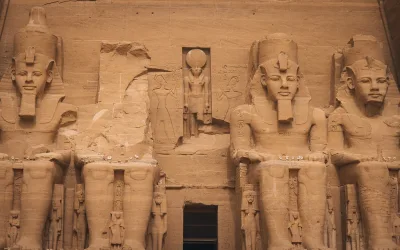
UNESCO World Heritage · Aswan, Egypt

Abu Simbel Temples Guide 2026 — Ramesses II, Solar Alignment & Visitor Tips

The twin rock-cut temples of Ramesses II and Queen Nefertari — UNESCO World Heritage marvel with four 20-metre colossi, the famous Sun Festival alignment, and one of antiquity's greatest engineering rescues.

Abu Simbel Temples: A Marvel of Ancient Egyptian Architecture

The Abu Simbel temples are among Egypt's most magnificent monuments, carved out of the mountainside in the 13th century BCE during the reign of Pharaoh Ramesses II. These remarkable temples, located in southern Egypt near the border with Sudan, stand as eternal symbols of ancient Egyptian art, architecture, and engineering brilliance.

Today the two rock-cut temples sit on the western shore of Lake Nasser, about 280 kilometres southwest of Aswan — drawing hundreds of thousands of visitors from around the world every year.

Abu Simbel Temple Exterior View - Majestic façade

The Twin Temples of Abu Simbel

Great Temple of Abu Simbel - Ramesses II

The Great Temple of Abu Simbel

Height: 30 meters Built: 1264 BCE Style: New Kingdom

Architectural Marvel

The Great Temple of Abu Simbel features four colossal statues of Ramesses II, each reaching 20 meters in height, guarding its entrance. This masterpiece of ancient Egyptian architecture was dedicated to the pharaoh and three major deities: Amun-Ra, Ra-Horakhty, and Ptah.

Interior Features

  • Eight massive statues of Ramesses II as Osiris
  • Detailed hieroglyphic inscriptions and battle scenes
  • Ancient Egyptian astronomical alignments
  • Three interconnected halls and sanctuaries
  • Famous Battle of Kadesh relief sculptures

Solar Alignment

Twice a year, on February 22 and October 22, the sun penetrates the Great Temple of Abu Simbel, illuminating the inner sanctuary and the statues of Ramesses II and the gods, except for Ptah, the god of the underworld.

Temple of Nefertari at Abu Simbel

The Temple of Nefertari at Abu Simbel

Height: 12 meters Built: 1264 BCE Style: New Kingdom

Dedication and Significance

The smaller temple at Abu Simbel, dedicated to Queen Nefertari and the goddess Hathor, represents a unique tribute in ancient Egyptian architecture where a queen's statues are the same size as those of the pharaoh.

Temple Features

  • Six colossal statues at the entrance
  • Rare depictions of the queen as goddess Hathor
  • Exquisite painted relief decorations
  • Unique architectural symmetry
  • Sacred shrine to Hathor-Nefertari

Historical Significance

This temple at Abu Simbel stands as testimony to Ramesses II's devotion to Nefertari and represents one of the few examples in Egyptian art where the queen's prominence equals that of the pharaoh.

UNESCO World Heritage Site

In the 1960s, the Abu Simbel temples faced submersion due to the construction of the Aswan High Dam. Through an unprecedented international rescue operation, both temples were carefully dismantled and relocated 65 meters higher and 200 meters back from their original location, preserving these irreplaceable monuments of ancient Egyptian civilization for future generations.

Abu Simbel Rescue Operation Facts

  • Duration: 4 years (1964-1968)
  • Cost: $40 million USD
  • Participating countries: 50
  • Weight of blocks moved: 250,000 tons
  • Number of blocks: Over 1,000

Historical Legacy of Abu Simbel

The temples of Abu Simbel stand as a testament to both ancient Egyptian grandeur and modern engineering ingenuity, representing over 3,000 years of history.

Towering Statues at Abu Simbel - A perspective view of the colossal statues of Pharaoh Ramesses II

Original Construction

Circa 1264-1244 BCE

Built during the reign of Ramesses II, the temples took approximately 20 years to complete. The massive complex was carved into the solid rock of a mountainside, showcasing the pinnacle of ancient Egyptian architectural achievement.

  • Carved entirely from living rock
  • Required thousands of skilled artisans
  • Aligned with astronomical precision
  • Featured advanced engineering techniques
Illuminated Interior of Abu Simbel - A stunning view of the temple's interior, glowing under golden lighting

Royal & Religious Significance

New Kingdom Period

The temples served multiple purposes, functioning as both a religious sanctuary and a political statement of power. They were strategically positioned to impress Egypt's southern neighbors and demonstrate Ramesses II's divine authority.

  • Dedicated to major Egyptian deities
  • Commemorated military victories
  • Displayed royal propaganda
  • Marked Egypt's southern frontier
Intricate Carvings Inside Abu Simbel - A close-up view of detailed ancient Egyptian carvings and hieroglyphs

Artistic Achievement

13th Century BCE

The temples showcase the finest examples of ancient Egyptian art and craftsmanship, featuring intricate reliefs and hieroglyphic inscriptions that have maintained their detail for over three millennia.

  • Detailed battle scenes
  • Religious ceremonies depictions
  • Royal family portraits
  • Elaborate hieroglyphic texts
Ancient Passageways Inside Abu Simbel - A traveler walking through the dimly lit corridors

UNESCO Rescue Operation

1964-1968

When the Aswan High Dam threatened to submerge the temples, an unprecedented international effort was launched to save them. This monumental project became a symbol of global cooperation in cultural preservation.

  • Complete dismantling and reconstruction
  • Relocated 65 meters higher
  • Preserved original solar alignment
  • Cost approximately $40 million
  • Involved 50 countries

Experience the Solar Alignment

Witness the remarkable Sun Festival at Abu Simbel

The Solar Alignment Phenomenon

6M+ Views February 23, 2022

Twice a year, on February 22 and October 22, a remarkable solar phenomenon occurs at Abu Simbel. The sun's rays penetrate the temple's sanctuary and illuminate the sculptures on the back wall, except for the statue of Ptah, the god of darkness.

Ancient Precision

Built with incredible astronomical accuracy over 3,000 years ago

Biannual Event

Occurs on February 22 and October 22 each year

Sacred Alignment

Illuminates statues of Ramesses II and the gods Ra-Horakhty and Amun

Available Tours

Visit Abu Simbel with a private guide — tours departing from Luxor, Hurghada, El Gouna, Safaga and Makadi Bay.

Private 2 Days Trip from Hurghada to Abu Simbel Most Popular

Private 2 Days Trip from Hurghada

Luxurious journey from Hurghada to Luxor & Abu Simbel with private guide

€350per person
Instant confirmation Book Now
Private Day Trip from Luxor to Abu Simbel Best Price

Private Day Trip from Luxor

Experience the magic of Abu Simbel with a day tour from Luxor

€110per person
Instant confirmation Book Now
Private 2 Days Trip from El Gouna to Abu Simbel Private Tour

Private 2 Days Trip from El Gouna

Comprehensive tour from El Gouna to Luxor & Abu Simbel

€400per person
Instant confirmation Book Now
Private 2 Days Trip from Safaga to Abu Simbel

Private 2 Days Trip from Safaga

Exclusive journey from Safaga to Luxor & Abu Simbel

€400per person
Instant confirmation Book Now
Private 2 Days Trip from Makadi Bay to Abu Simbel

Private 2 Days Trip from Makadi Bay

Memorable adventure from Makadi Bay to Luxor & Abu Simbel

€400per person
Instant confirmation Book Now

Want to see Abu Simbel in person?

Day trips and overnight tours from Aswan, Luxor, Cairo, Hurghada and beyond — flights, sleeper trains, private cars and Lake Nasser cruises. Free cancellation on most tours.

View all Abu Simbel tours

Key Facts & Statistics

Dimensions & Scale

  • Great Temple Height: 30 meters (98 feet)
  • Colossal Statues: 20 meters (66 feet) each
  • Nefertari Temple Height: 12 meters (39 feet)
  • Total Site Area: 3,000 square meters
  • Rock Removed: 200,000 cubic meters

Historical Timeline

  • Construction Period: 1264-1244 BCE (20 years)
  • Pharaoh: Ramesses II (Ramesses the Great)
  • Rediscovered: 1813 CE by Johann Burckhardt
  • UNESCO Rescue: 1964-1968 (4 years)
  • UNESCO Status: World Heritage Site since 1979

Visitor Statistics

  • Annual Visitors: Over 500,000
  • Peak Season: October to April
  • Sun Festival Attendance: 5,000+ per event
  • Average Visit Duration: 2-3 hours
  • Tourist Rating: 4.8/5 stars

Geographic Location

  • Coordinates: 22.3372°N, 31.6258°E
  • Region: Aswan Governorate, Upper Egypt
  • Distance from Aswan: 280 km (174 miles)
  • Distance from Cairo: 1,150 km (715 miles)
  • Nearest Airport: Abu Simbel Airport (3 km)

Architectural Features & Design

Great Temple Facade

  • Four colossal seated statues of Ramesses II
  • Each statue weighs approximately 1,200 tons
  • Statues flanked by smaller figures of family members
  • Intricate battle scenes carved above entrance
  • Hieroglyphic inscriptions cover entire facade

Interior Halls

  • Hypostyle Hall with 8 Osiris pillars
  • Second Hall with 4 pillars
  • Vestibule leading to inner sanctuary
  • Total depth: 63 meters (207 feet)
  • Precision-cut chambers maintain perfect alignment

Artistic Elements

  • Vibrant painted reliefs depicting battles
  • Religious ceremonies and offerings
  • Royal family portraits and scenes
  • Original colors preserved in protected areas
  • Over 3,000 years of artistic preservation

Astronomical Alignment

  • Precisely oriented to face east
  • Solar alignment occurs twice annually
  • Illuminates inner sanctuary at exact times
  • Demonstrates advanced astronomical knowledge
  • Alignment preserved after relocation

Nefertari Temple Features

  • Six standing statues at entrance (4 Ramesses, 2 Nefertari)
  • Unique equal-size representation of queen
  • Dedicated to goddess Hathor
  • Smaller but equally impressive design
  • Rare example of queen's prominence

Construction Techniques

  • Carved entirely from living rock
  • No separate blocks or masonry
  • Advanced geometry and measurements
  • Precision engineering without modern tools
  • Masterful stone carving techniques

Cultural & Historical Significance

Political Statement

Abu Simbel served as a powerful political statement of Ramesses II's authority and divine status. Positioned at Egypt's southern frontier, the temples were designed to impress and intimidate Nubian neighbors while demonstrating the pharaoh's connection to the gods.

  • Demonstrated military might through battle scenes
  • Established divine kingship through religious imagery
  • Marked territorial boundaries of ancient Egypt
  • Showcased royal power to foreign visitors

Religious Importance

The temples were dedicated to major Egyptian deities and served as active religious centers. The Great Temple honored Amun-Ra, Ra-Horakhty, Ptah, and the deified Ramesses II, while the smaller temple celebrated Hathor and Nefertari.

  • Daily religious ceremonies and offerings
  • Solar festivals marking agricultural calendar
  • Connection between pharaoh and gods
  • Eternal worship of Ramesses II

UNESCO World Heritage

The UNESCO rescue operation of Abu Simbel became a symbol of international cooperation in cultural preservation. This monumental effort demonstrated humanity's commitment to protecting shared heritage for future generations.

  • 50 countries participated in rescue operation
  • Cost $40 million USD (equivalent to $300M today)
  • Set precedent for future heritage preservation
  • Recognized as one of UNESCO's greatest achievements

What to See at Abu Simbel

Great Temple Exterior

  • Four colossal statues of Ramesses II
  • Intricate facade carvings and inscriptions
  • Battle scenes and royal imagery
  • Perfect symmetry and proportions
  • Morning light creates dramatic shadows

Interior Chambers

  • Hypostyle Hall with Osiris pillars
  • Detailed wall reliefs and paintings
  • Battle of Kadesh scenes
  • Religious ceremony depictions
  • Inner sanctuary with deity statues

Nefertari Temple

  • Six entrance statues
  • Hathor-themed decorations
  • Queen's prominence in art
  • Intimate chamber design
  • Unique architectural features

Solar Alignment (Feb 22 / Oct 22)

  • Sunlight penetrating inner sanctuary
  • Illumination of deity statues
  • Ptah remains in shadow (god of darkness)
  • Precise astronomical phenomenon
  • Once-in-a-lifetime experience

Hieroglyphic Inscriptions

  • Extensive text coverage
  • Religious spells and prayers
  • Historical records and dates
  • Royal titles and epithets
  • Well-preserved ancient writing

UNESCO Relocation Site

  • Modern engineering achievement
  • Relocation documentation center
  • Original location markers
  • Preservation techniques display
  • International cooperation story

Interesting Facts About Abu Simbel

Did You Know?

  • The temples were completely buried in sand when rediscovered in 1813
  • One statue's head fell off in ancient times and was never replaced
  • The relocation shifted the solar alignment by one day
  • Each block weighed up to 30 tons during relocation
  • The temples were originally called "Temple of Ramesses, Beloved of Amun"

Amazing Achievements

  • Built entirely by hand without modern machinery
  • Astronomical precision achieved 3,000+ years ago
  • Relocation maintained 99.9% accuracy
  • Original colors still visible in protected areas
  • Survived earthquakes, floods, and time

Global Impact

  • Inspired similar rescue operations worldwide
  • Featured in numerous documentaries and films
  • Subject of extensive academic research
  • Symbol of international cultural cooperation
  • Recognized as one of Egypt's "Seven Wonders"

Photography Highlights

  • Best lighting: Early morning (6-9 AM)
  • Golden hour creates dramatic shadows
  • Interior photography requires permit
  • No flash photography inside temples
  • Sunrise over Lake Nasser is spectacular

Essential Visitor Information

Everything you need to know for your visit to Abu Simbel

Best Time to Visit

Optimal Seasons

  • October to April: Best weather conditions
  • Early morning visits recommended (cooler temperatures)
  • Sunrise to 9 AM: Ideal photography lighting

Sun Festivals

Special dates when sunlight illuminates the inner sanctuary:

  • February 22nd
  • October 22nd

Getting There

Transportation Options

  • Direct flights from Cairo to Abu Simbel Airport
  • Organized tours from Aswan (most popular)
  • Private car transfers available
  • Cruise ship excursions on Lake Nasser

Journey Times

  • Flight from Cairo: ~3 hours
  • Drive from Aswan: ~3.5 hours
  • Cruise from Aswan: ~1-2 days

Practical Tips

What to Bring

  • Sunscreen and hat (essential)
  • Comfortable walking shoes
  • Water bottle
  • Camera (photography permit required)

Visitor Guidelines

  • Modest dress recommended
  • Early booking essential for festivals
  • Guide services available on-site

Opening Hours & Fees

Visiting Hours

  • October to April: 6:00 AM - 5:00 PM
  • May to September: 6:00 AM - 6:00 PM
  • Special hours during festivals

Admission Fees

  • Adult Ticket: approx. 750 EGP (as of 2026, subject to change)
  • Student Ticket: approx. 375 EGP (with valid ID)
  • Photography Pass: Additional fee required

Sun Festival Tip

The Sun Festivals on February 22 and October 22 attract thousands of visitors every year. Book your tour and accommodation several months in advance and plan a very early arrival — the light phenomenon lasts only about 20 minutes after sunrise.

Abu Simbel in Numbers

Facts that capture the sheer scale of this monument.

3,200+Years of history
20 mColossal statue height
250,000 tStone relocated (1964–68)
50Countries joined the rescue

Frequently Asked Questions About Abu Simbel

Answers to the most important questions about visiting, getting there and the Sun Festival.

What are the opening hours of the Abu Simbel temples?
Abu Simbel temples are open daily. From October to April: 6:00 AM – 5:00 PM, and from May to September: 6:00 AM – 6:00 PM. Special hours may apply during the Sun Festivals.
How much does it cost to visit Abu Simbel?
Admission (as of 2026) costs approximately 750 EGP for adults and 375 EGP for students (with valid ID). An additional photography pass is required for professional photography. Prices are subject to change.
When is the best time to visit Abu Simbel?
The best time to visit Abu Simbel is from October to April for optimal weather conditions. Early morning visits (sunrise to 9 AM) are recommended for cooler temperatures and ideal photography lighting. The Sun Festivals on February 22nd and October 22nd are special dates when sunlight illuminates the inner sanctuary.
How do I get to Abu Simbel from Cairo or Aswan?
You can reach Abu Simbel via direct flights from Cairo to Abu Simbel Airport (about 3 hours), organized tours from Aswan (most popular option, about 3.5 hours drive), private car transfers, or cruise ship excursions on Lake Nasser (1–2 days). Egyptra also offers private 2-day tours from Hurghada, El Gouna, Safaga and Makadi Bay.
What is the Sun Festival at Abu Simbel?
The Sun Festival occurs twice yearly on February 22 and October 22, when the sun's rays penetrate the Great Temple and illuminate the inner sanctuary sculptures of Ramesses II and the gods Ra-Horakhty and Amun. Remarkably, the statue of Ptah, god of darkness, remains in shadow. This phenomenon demonstrates the ancient Egyptians' advanced astronomical knowledge.
What should I bring when visiting Abu Simbel?
Essential items include: sunscreen and hat (essential due to desert sun), comfortable walking shoes, water bottle, and camera (photography permit required). Modest dress is recommended, and early booking is essential for festival dates.
Are there wheelchair accessible areas at Abu Simbel?
Yes, Abu Simbel has wheelchair accessible areas. The site features paved pathways and designated viewing areas. However, some interior chambers may have limited accessibility due to the ancient architecture. It's recommended to contact the visitor center in advance for specific accessibility arrangements.
Can I take photos inside the Abu Simbel temples?
Photography is allowed at Abu Simbel, but you need to purchase a photography permit in addition to your entrance ticket. Flash photography is prohibited inside the temples to protect the ancient artwork. Professional photography equipment may require special permissions.
How long was the UNESCO rescue operation of Abu Simbel?
The UNESCO rescue operation took 4 years (1964–1968) and cost approximately $40 million USD. It involved 50 participating countries and required moving over 250,000 tons of blocks. The temples were carefully dismantled and relocated 65 meters higher and 200 meters back from their original location to save them from the rising waters of Lake Nasser.
What are the dimensions of the Abu Simbel temples?
The Great Temple of Abu Simbel stands 30 meters high with four colossal statues of Ramesses II, each 20 meters tall. The smaller Temple of Nefertari is 12 meters high with six statues at the entrance. The entire complex covers approximately 3,000 square meters.
How long does a visit to the Abu Simbel temples take?
Plan around 2 to 3 hours on site to explore both temples at a relaxed pace — the Great Temple of Ramesses II and the Temple of Nefertari. Including the journey from Aswan, allow half a day to a full day for the excursion.
Who built the temples of Abu Simbel?
The temples were built in the 13th century BCE under Pharaoh Ramesses II. Construction began around 1264 BCE and took about 20 years. The Great Temple was dedicated to Ramesses II himself and the gods Amun-Ra, Ra-Horakhty and Ptah, while the smaller temple honored his wife Queen Nefertari and the goddess Hathor.
Why were the temples of Abu Simbel relocated?
The construction of the Aswan High Dam in the 1960s meant the rising waters of Lake Nasser threatened to flood the temples. In an unprecedented UNESCO rescue operation (1964–1968), both temples were cut into over 1,000 blocks and faithfully rebuilt 65 meters higher and 200 meters further inland — preserving the original solar alignment.
Can I visit Abu Simbel from Hurghada or El Gouna?
Yes. Egyptra offers private 2-day tours from Hurghada, El Gouna, Safaga and Makadi Bay that combine Luxor and Abu Simbel — including transfers, a private guide and overnight accommodation. From Luxor, a private day trip is also available.
Is Abu Simbel worth visiting?
Absolutely. Alongside the Pyramids of Giza, Abu Simbel ranks among Egypt's most impressive monuments: four 20-meter colossal statues, over 3,000 years of history and the unique solar alignment phenomenon make a visit an unforgettable highlight of any trip to Egypt.

Still have questions?

Our team is happy to help — reach out via WhatsApp, email, or call +20 101 195 7868. Or .

Related pages & tours

Aswan tours

Ready to experience the wonder of Abu Simbel?

Secure your private tour to the temples of Ramesses II and Nefertari — with a private guide, comfortable transfers and personal service from Egyptra.

Explore tours WhatsApp
Chat with us!

Site map

65